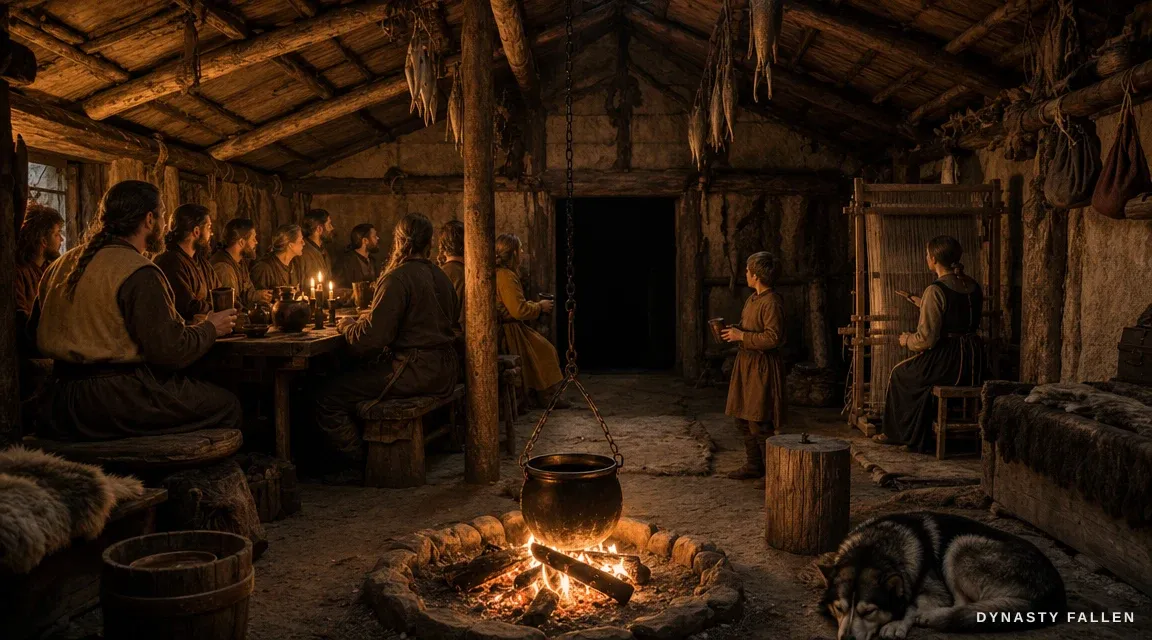
Two lines spoken with a cold Norse breath over frame-drum gallop, palm-muted Dorian-dark electric guitar and sparse bowed-lyre talharpa from the first beat. Then sung — full band, driving.
They gave her one saga — clean, valiant, brave. I asked for the other — and I wrote it too. She sailed a second keel for Vinland's shore, With Helgi and Finnbogi — at the second oar. A winter camp, a quarrel born untrue, She named the brothers struck her — the order grew.
Pre-Chorus
Tightening — the frame drum doubles, the first war-horn lurr hit, bowed lyre rising.
The axe was passed — the husband stayed, The colder hand, the colder trade.
Chorus
Full band driving with menace — twin-guitar harmonies dark, double-kick locked, Norse horn lurr accents, minor Dorian.
The axe in hand, the doorway stark, A winter camp, a colder mark, The other saga, the other line, I took the axe — the saga's mine.
Verse 2
Sung full band — the palm-muted Dorian dark thicker, frame-drum gallop, bowed lyre cold and sparse, war-horn lurr in the tail.
She sent her husband with the axe to hold, He killed the brothers — but the women, no. He turned his face — would not let his hand fall, She took the axe back — and crossed the snow. The doorway dark, the longhouse held its breath, Erik's daughter signed the colder death.
Pre-Chorus 2
Thickening — the frame drum doubles harder, the second war-horn lurr hit, bowed lyre held.
The axe was raised — the husband paled, The colder hand, the colder tale.
Chorus 2
Full band driving with menace, louder — twin-guitar harmonies dark, double-kick locked, Norse horn lurr accents.
The axe in hand, the doorway stark, A winter night, a darker mark, The other saga, the other name, I took the axe — the saga came.
Bridge
Drums half-time, soprano lift on the last line, women's chorus underneath, bowed lyre soaring, extended war-horn lurr, lead guitar with edge.
The husband faltered, the axe stood still, She took the weight — she had the will, The Grœnlendinga, the cold ink page, I took the axe — and the saga was mine.
Instrumental
Eight bars — lead guitar with edge and extended war-horn lurr over frame-drum gallop and bowed lyre. Roughly thirteen seconds.
Final Chorus
Full band at its biggest — lead guitar over the second half, twin-guitar harmonies, double-kick locked, climactic war-horn lurr accents, women's chorus locked.
The axe in hand, the doorway stark, The longhouse stilled, the saga's mark, The other saga, the longer page, I took the axe — both sagas, mine.
Outro
The frame drum fades to a single beat, a final war-horn lurr tail, hard cut.
The other saga. Mine too. The colder line — both saw, both true.
Early eleventh century · the winter camp of the second Vinland expedition · the false accusation, the axe, the killings
Source: Grœnlendinga saga, ch. 8 (Flateyjarbók) — the episode is single-source; Eiríks saga rauða knows nothing of it
Named figures
Freydís EiríksdóttirLeader of the second expedition in the Grœnlendinga account; she falsely accuses the brothers, demands their deaths — and when no man will kill the five women of their party, takes the axe herself
ThorvardHer husband; the saga records him carrying out the killing of the brothers’ men at her demand and faltering at the women — the track holds him in silhouette
Helgi and FinnbogiIcelandic brothers who sailed in partnership with Freydís; the saga records a winter of broken terms, the false accusation that they had struck her, and their deaths with their company
The five womenThe women of the brothers’ party, whom no man would kill; Grœnlendinga saga records Freydís killing them herself. The album does not render them — the camera stops at the doorway
What this song renders
Grœnlendinga saga records a second Vinland expedition mounted jointly by Freydís and the Icelandic brothers Helgi and Finnbogi, and a winter in which the partnership’s terms broke down. Freydís then told her husband Thorvard that the brothers had beaten her, and goaded him — under threat of divorce, in the saga’s telling — into taking armed men to the brothers’ longhouse at dawn. The men of the rival party were bound and killed. When none of Thorvard’s men would raise a hand against the five women, the saga records that Freydís asked for an axe and killed them herself, swore her company to silence, and sailed home to Greenland with a different story.
The saga’s aftermath is part of the record the track inherits: word escaped, and Leif Erikson — her half-brother — forced the truth from members of her crew, declined to punish her, and foretold that her line would not prosper. The track takes none of this back. Its register is testimony — the witness who asked for the other saga refuses to soften it (“a quarrel born untrue” concedes the accusation was false) and refuses equally to disown it: “the other saga, mine too.”
The rendering carries the album’s structural reservation. The killings of the brothers happen in silhouette at distance; the five women are never shown — the camera withdraws at the longhouse doorway and the audience is told what happened, not shown. The bearded war-axe replaces the iron sword of Tracks 04–06 as the visual register of the saga-shift: a different weapon-state for a different saga, the same woman.
Verdict
The killings are sagaic and single-source — Grœnlendinga saga alone records the second expedition, the false accusation, the axe, and the five women; Eiríks saga rauða contains none of it and gives her the bareblade at Hóp instead. No third source arbitrates between them. The album’s posture is the song’s closing line — testimony held alongside Track 05’s: both saw, both true.