viii.

Saga of Ice, Saga of Snow

Act III — The Other Saga Released Approx. 4:20
Verse 1
Two lines spoken in a Norse hush, dawn-grey and contemplative, over frame-drum heartbeat, bowed-lyre talharpa and low whistle counter from the first beat. Then sung with restraint.

Before the bareblade. Before the axe.
There was Erik's daughter — who signed both pages.
They wrote her valiant in the saga of ice,
They wrote her cold in the saga of snow,
Both pages signed by the same Norse hand,
Both sagas hers — and the chronicles know.

Pre-Chorus
Bowed lyre rising, the frame-drum heartbeat firming, low whistle held, bouzouki entering softly underneath.

The page was one. The hand was one.
The saga held — and the song was done.

Chorus
Full band, gentle and ballad-restrained — soft twin-guitar harmonies, no double-kick, bowed lyre soaring under, women's chorus locked but soft, major key.

Erik's daughter — bareblade and axe,
The hand and the hand, the saga's tracks,
Both pages signed, both sagas mine,
Both were true — the saga's line.

Verse 2
Sung with growing weight — the frame-drum heartbeat firmer, bowed lyre held, low whistle counter, bouzouki firmer, the pivot into minor.

She will not choose — the saga is one,
She does not need to — the page is done,
The bareblade lifted, the axe came down,
Both pages signed — the same hand bound.
Both were true — the page held all,
Both were true — both sagas call.

Pre-Chorus 2
Bowed lyre soaring, the heartbeat doubling, low whistle held, a bouzouki strum accent — now in minor.

The page was hers. The hand was hers.
The saga held — and the song was hers.

Chorus 2
Full band louder but still a ballad — twin-guitar harmonies, no double-kick yet, bowed lyre soaring under, women's chorus louder, the minor pivot holding.

Erik's daughter — bareblade and axe,
The hand and the hand, the saga's pacts,
Both pages signed, both sagas hers,
Both were true — the saga stirs.

Bridge
Drums half-time, bowed lyre soaring with a bouzouki strum accent, the soprano lift approaching on the last two lines, women's chorus underneath.

The bareblade lifted, the axe came down,
The page held both — the saga's crown,
Both were true. Both are mine.
The page is mine — and the line is mine.

Instrumental
Eight bars — lead guitar with restraint and soaring bowed lyre over doubled frame-drum heartbeat and bouzouki, building toward the Final Chorus. Roughly nineteen seconds.
Final Chorus
The biggest moment on the album — full band, double-kick locked for the only time, twin-guitar harmonies climactic, lead guitar with restraint over the second half, women's chorus locked, soprano lift on the last line.

Erik's daughter — bareblade and axe,
The hand and the hand, the saga's acts,
Both pages signed, both sagas true,
Both were true — both pages knew.

Outro
Hard cut after the Final Chorus — no fade, no instrumental tail, a beat of silence. Then the separately recorded whisper, dry and close to the mic, and a hard cut to black.

Both were true.

The history

Early eleventh century, written down two and three hundred years later · a dawn-grey Atlantic shore outside both sagas · one woman, two pages, no arbitration

Source: Eiríks saga rauða (Hauksbók, Skálholtsbók, c. 13th c.) and Grœnlendinga saga (Flateyjarbók, c. 14th c.), read together — the album’s two primary sources in honest contradiction

Named figures

  • Freydís Eiríksdóttir The only figure in the Norse-Atlantic record to carry two flatly contradictory sagas of equal standing — valiant with a sword in one, an axe against five women in the other. The track renders both: same face, same shore, two registers
  • Erik the Red Her father — the fact both sagas agree on. The lineage Track 01 opened with is the spine the contradiction hangs from
  • Leif Erikson Her half-brother, present in both saga traditions; in Grœnlendinga saga he learns the truth of the killings and will not punish her — the record’s own refusal to close the case
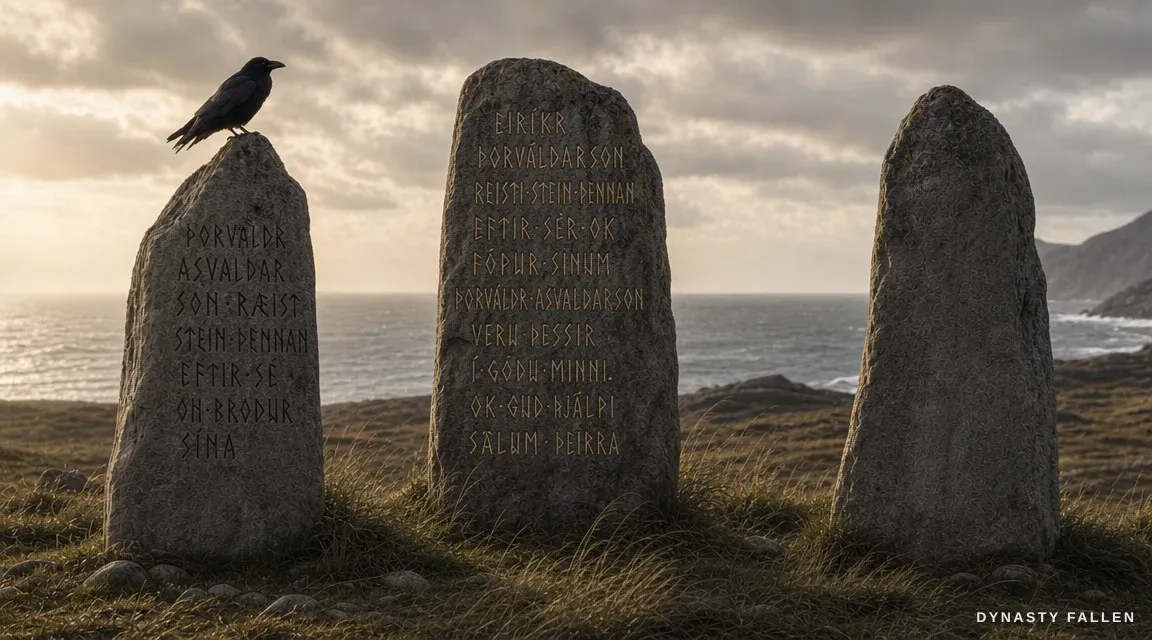
Three weathered memorial stones standing on a windswept grove — one woman, two pages, no arbitration.

What this song renders

The two texts cannot both be right, and neither can be corrected against the other. Eiríks saga rauða gives Freydís the bareblade at Hóp — pregnant, abandoned, valiant — and knows nothing of killings at a winter camp. Grœnlendinga saga gives her the second expedition, the false accusation, and the axe — and knows nothing of Hóp. Both descend from the same Norse-Atlantic memory of the same woman; both were written down in Iceland centuries after her lifetime; both survive in medieval manuscripts of comparable authority. Modern scholarship has not arbitrated, because there is nothing to arbitrate with: no third source exists.

The closer makes the historiography the staging. The two Freydíses the album has held apart — the bareblade register of Eiríks saga rauða and the axe register of Grœnlendinga saga — appear in the same frame for the first time, mirror-staged on a deliberately neutral dawn-grey shore: no longhouse, no camp, no period architecture, a thesis setting rather than a saga setting. They alternate verses, share the choruses, and at the whisper both turn to the camera and both mouths carry the words. The emptiness of the shore is the point — after seven tracks of populated Norse-coastal world, the closer strips everything but the contradiction.

The whispered verdict — “Both were true” — is the album’s epigraph thesis landing as its final word, in past tense: the question is historical now. The withheld outro that the catalogue normally resolves with a name-stamp stays withheld here, as it did at the bareblade — the only two such moments on the record, the centerpiece and the closer answering each other.

Verdict

The contradiction itself is the documented fact — both manuscripts survive, both record Freydís Eiríksdóttir, and they flatly disagree. Everything either saga says about her Vinland years is sagaic, single-source by definition wherever the texts diverge. The whispered verdict — both were true — is the album’s stance, not a finding: Vol. VIII takes the two medieval contradictions as historical record and lets the contradiction itself be the song.

Read the full Truth, Saga & Legend page