What this song renders
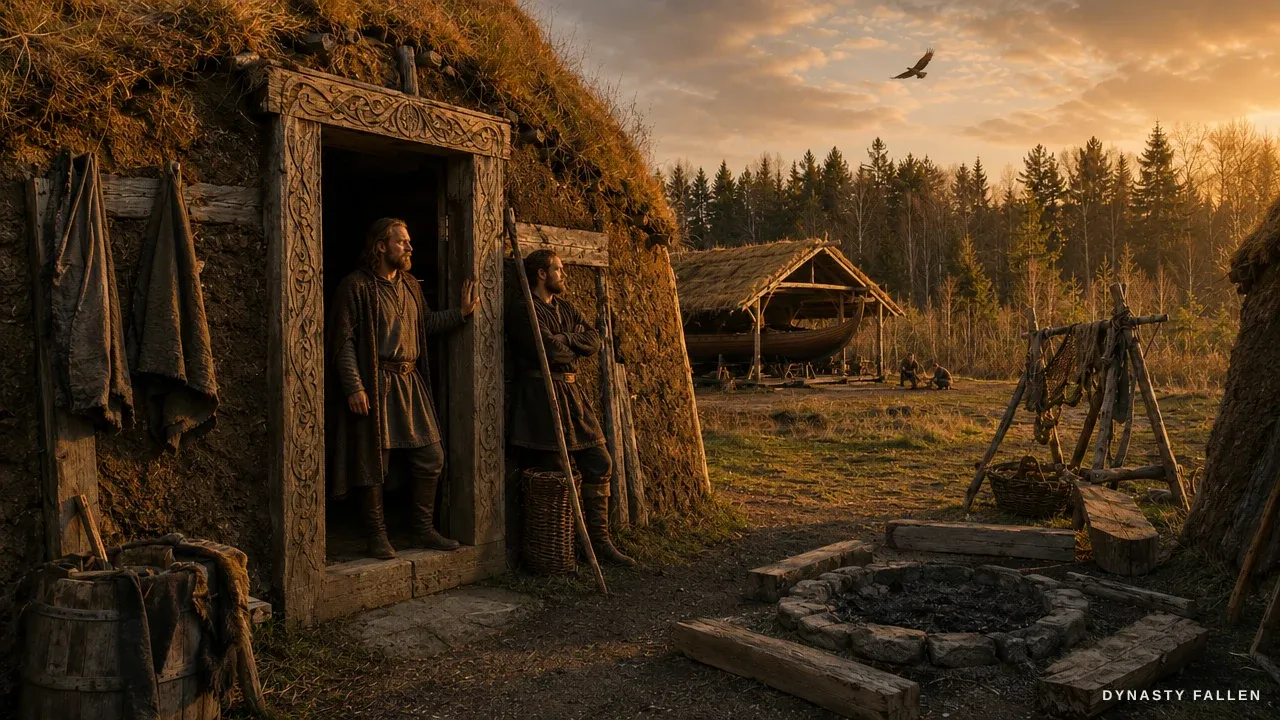
The Norse-Vinland voyages are the most archaeologically anchored of the saga episodes. Helge and Anne Stine Ingstad’s excavation at L’Anse aux Meadows on the northern tip of Newfoundland (1960–1968) recovered the foundations of eight Norse turf-and-timber buildings, period-accurate Viking-age iron nails, a soapstone spindle whorl, and a bronze ring-headed pin — the only confirmed pre-Columbian Norse settlement in North America. The site dates to c. 1000 and is consistent with the saga record of three or four short-lived expeditions in the first two decades of the eleventh century. The green coast was real; the keels did rise; the saga numbers compress what was almost certainly a smaller fleet than forty — but the documented mortality is real.
Eiríks saga rauða places Freydís on the Karlsefni expedition; Grœnlendinga saga gives her a separate command of her own a few years later. The two saga sources disagree on almost every detail of her life — this is the album’s central historiographical conceit. Track 03 sits inside the documented frame: the brothers’ expeditions, the Karlsefni fleet, the green coast first-seen, the cost of the crossings. Thorvald’s arrow-death is a saga episode but with archaeological corroboration — the Norse did meet Indigenous Maritime peoples on these shores, and the violence is recorded on both saga sides.
The track’s gendered turn in the bridge — “the men named what they reached and lost — but the land lay wide for the women too” — is the album’s first explicit thesis statement. It is not a saga line; it is the album’s argument, planted here and paid off in Track 06 (Iron and Ink) and Track 08 (Saga of Ice, Saga of Snow). The Final Chorus closing line “Erik’s daughter, and both lands mine” seeds the album’s both-thesis — Greenland and Vinland, and later, both sagas.
The Norse-Vinland voyages, the Karlsefni expedition, Leif’s c. 1001 voyage, and Thorvald’s arrow-death are documented in both sagas and archaeologically supported at L’Anse aux Meadows. The fleet number forty is the album’s saga-stylized inheritance — the historical fleet was almost certainly smaller (the sagas give counts in the 60-person, 3-ship range for Karlsefni). The gendered bridge claim and the “both lands mine” closure are the album’s thesis, not the saga record — the song is open about being an argument laid onto the documentary frame.