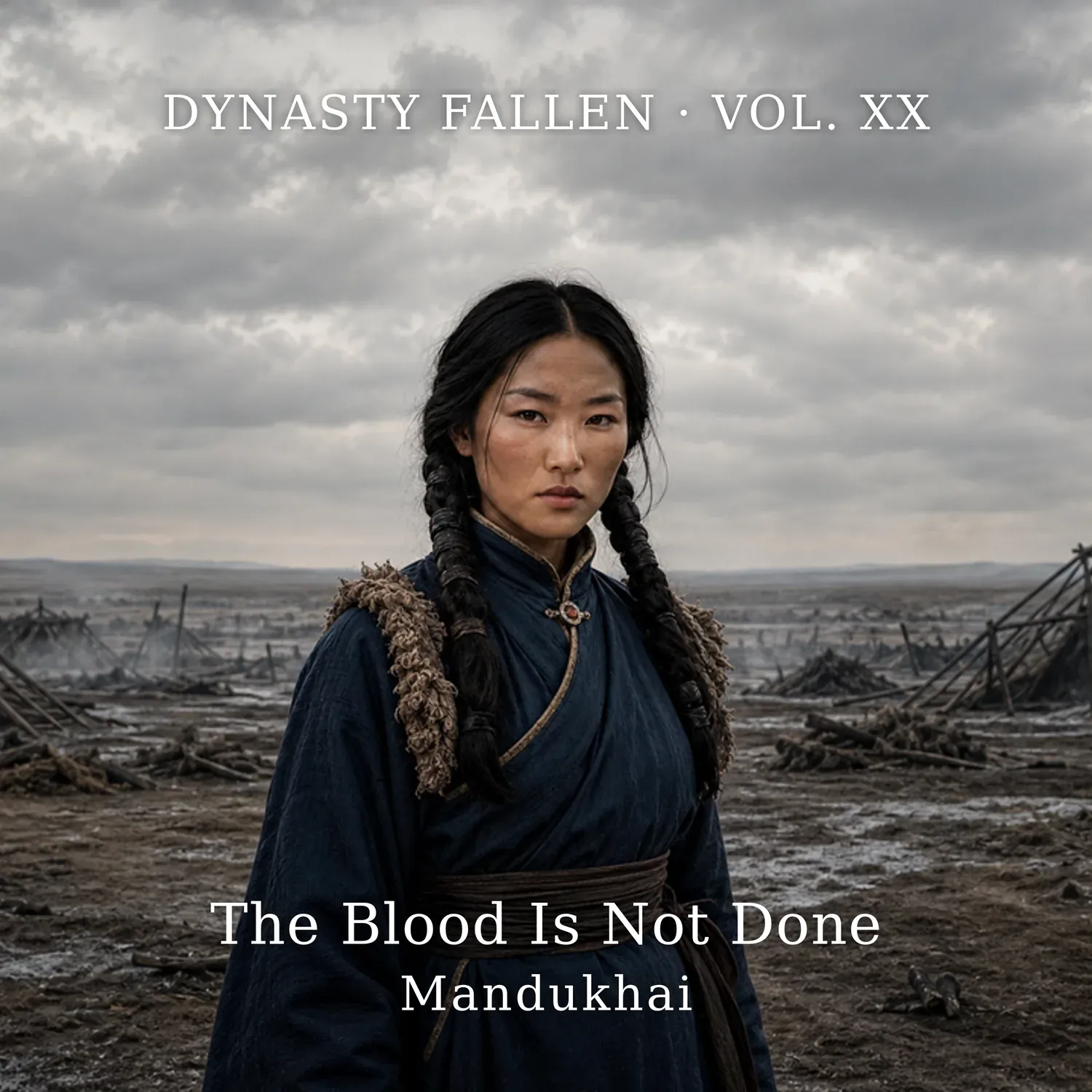
Dynasty Fallen · Vol. XIV

Mandukhai
the Wise

Mandukhai the Wise. She rebuilt an empire — the record named the boy she made.
You will remember the khan. I am the one who made him.

The story

Fifteenth century AD
The Mongolian steppe, a century after empire
The widow who refused to let the house of Genghis fall

Mandukhai (c. 1449–1510) was a queen of the Northern Yuan — the Mongol state that outlived Kublai Khan’s empire and then, for a hundred years, tore itself apart. By the time she was widowed, the line of Genghis Khan had been hunted almost to extinction and the steppe had fractured into feuding tribes and Oirat warlords. She was the widow everyone meant to marry off: a crown to be won, a legitimacy to be inherited.

She refused. Instead she brought a seven-year-old orphan out of hiding — Batmönkh, the last living descendant of Genghis — adopted him, had him proclaimed Dayan Khan, and ruled for him while she went to war. She broke the Oirats, imposed submission on the western tribes, and reunified the Eastern Mongols under one banner for the first time in a century. Years later she married the khan she had made, to bind regent and khan into one house. The chronicles say she rode her last campaign heavily pregnant and delivered twins in the field. She bore seven sons and three daughters, and nearly every later khan of Mongolia descends from her.

“They will call it the work of a khan. It started with a woman in the ash.”

Vol. XIV follows her arc in three acts: The Ruin, The Choice, and The Line Restored. Eight tracks. It is the catalogue’s rare restoration story — not a dynasty falling, but a widow refusing to let one stay fallen — and it ends on the thing the record did to her: the reunification remembered as the boy’s, and the woman who engineered it written out. The documented reunification and the chronicle legend sit side by side; the Truth & Legend page is so you can hold both at once.

Album in active production. 1 of 1 tracks released.

Music videos

Out now.

The album opens in the ash of empire — a widow handed the wreck of the Mongol world, refusing to let the house of Genghis stay fallen. The thesis is planted in the first track’s outro: they will call it the work of a khan; it started with a woman in the ash.

Track list

One tracks. Three acts.

Three acts: the ruin she inherits and the strongman’s offer refused; the orphan heir she raises to the throne and the war she wins to keep it; the line restored — and the name that swallows hers.

Questions

About Mandukhai.

The short answers — with links into the lyrics and the annotated history where the record gets interesting.

Who was Mandukhai Khatun?
Mandukhai (c. 1449–1510), remembered as Mandukhai Sechen — ‘the Wise’ — was a queen of the Northern Yuan, the Mongol state that survived the fall of Kublai Khan’s empire. Widowed young, she refused to marry the warlord circling her throne and instead adopted a seven-year-old orphan — the last living descendant of Genghis Khan — had him proclaimed Dayan Khan, and ruled for him while she fought to reunify the Mongols. Dynasty Fallen Vol. XIV traces her whole arc across eight tracks.
Was Mandukhai a real historical person?
Yes. The reunification of the Eastern Mongols and the enthronement of the boy-khan Dayan Khan are the documented spine of late-fifteenth-century Mongol history. What is less certain is the vivid detail — the refusal of the strongman, the pregnant charge, the twins born in the field — which comes from Mongolian chronicles written over a century later. The Truth & Legend page sorts the documented from the saga.
Did Mandukhai really marry her adopted son?
According to the chronicles, yes — and the two facts are usually told badly out of order. She adopted the orphan Batmönkh and had him crowned Dayan Khan when he was about seven; she married him years later, when he had grown to around nineteen, to bind regent and khan into one house and keep her command. The album states both ages plainly, because the act was a piece of dynastic statecraft, not a romance.
Who was Dayan Khan?
Batmönkh Dayan Khan (c. 1472–1517) was the orphaned Genghisid heir Mandukhai raised to the throne. He became the longest-reigning unified Mongol khan and reorganised the eastern tribes into the six tümens; nearly all later Mongol nobility, including Altan Khan and the last Northern Yuan ruler Ligdan Khan, descend from him and Mandukhai. In the popular memory the reunification is often remembered as his — which is exactly the album’s subject.
Did Mandukhai really ride to war while pregnant?
That is the image the whole legend turns on: the chronicles describe her leading a campaign against the Oirats heavily pregnant, being thrown from her horse and rescued, and delivering twin boys in the field. It is a saga-tradition detail, recorded more than a century after the fact, not a contemporary report — stirring, and impossible to verify. The Truth & Legend page treats it as saga.
Is Mandukhai related to Genghis Khan?
By marriage and through her children, yes. She married into the Borjigin line — Genghis Khan’s dynasty — and the heir she raised, Dayan Khan, was a direct male descendant of Genghis. Their seven sons and three daughters are the ancestors of nearly all the later khans and nobles of Mongolia, which is why she is sometimes called the grandmother of the reunified Mongol nation.
Why is Mandukhai so famous in Mongolia but little known elsewhere?
In Mongolia she is a national heroine, carried for generations by folklore and above all by the 1988 film Mandukhai the Wise Queen. In the English-speaking world she was almost unknown until Jack Weatherford’s The Secret History of the Mongol Queens (2010) brought her to a wider audience. Her story sits in a wide-open lane — a first-rank historical drama that Western popular culture has barely touched.

Where to listen

New tracks drop through the cycle.

Stream the album on your service of choice. Music videos go up on YouTube.