The story
Late eighteenth century
Versailles, Paris, the Revolution
The Austrian queen the Revolution needed as its monster
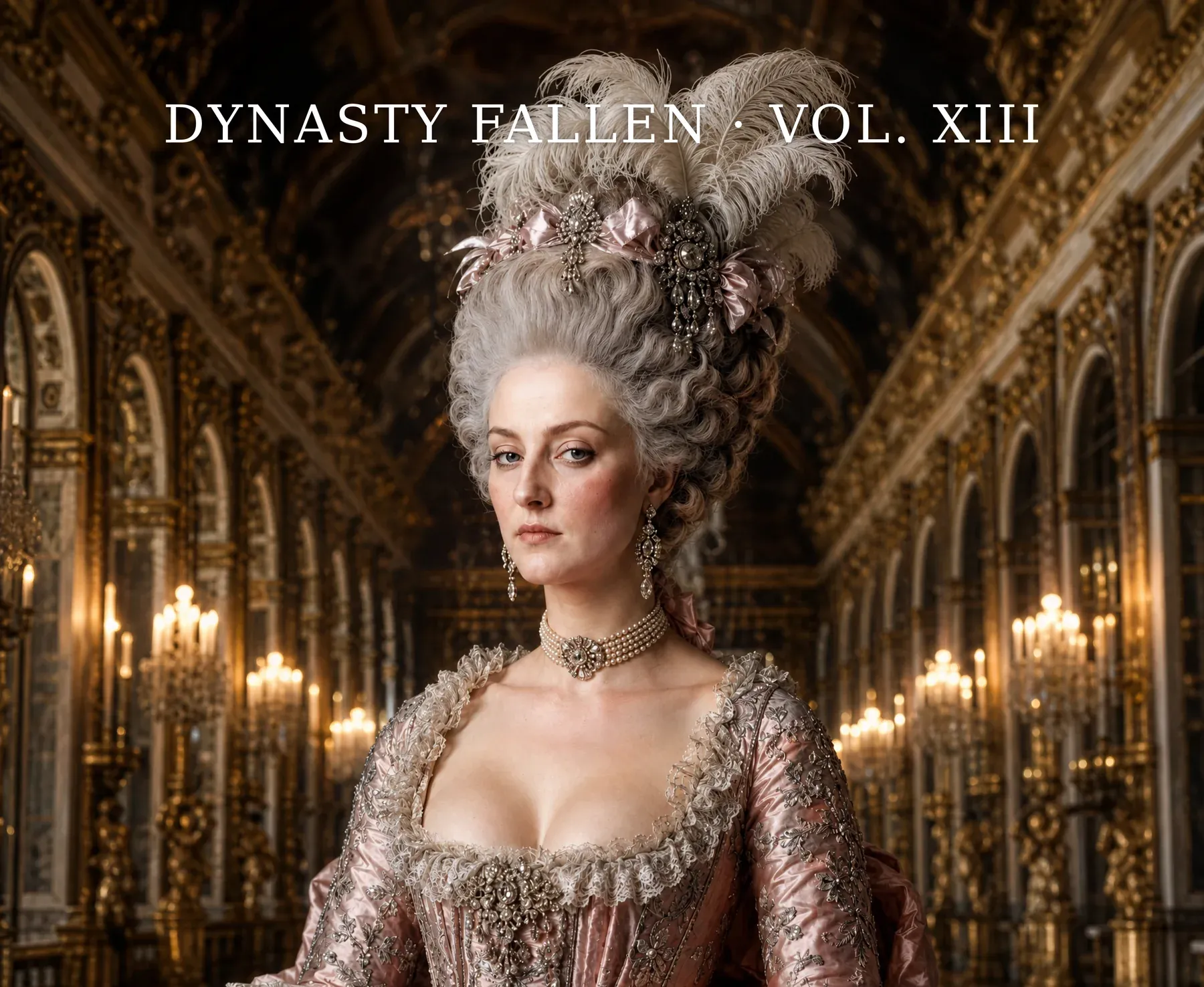
Marie Antoinette (1755–1793) was born Maria Antonia of Austria, fifteenth child of Empress Maria Theresa, and married at fourteen to the future Louis XVI to seal the Franco-Austrian alliance. She was Queen of France from 1774 until the monarchy fell in 1792, and was guillotined on 16 October 1793 — l’Autrichienne, the Austrian woman the court distrusted before she had done anything, and the Revolution needed as the face of everything it hated.
Vol. XIII is the catalogue’s first villain-myth, the exact inverse of Vol. XI Anastasia. There, a murdered woman was made nicer than she was — resurrected as a fairy-tale survivor. Here, a murdered woman was made worse than she was — buried under a line she never spoke (Rousseau’s, written around 1765, when she was a child in Austria), a necklace she never bought (the Diamond Necklace fraud she had no part in), and a ‘playing shepherdess’ image that is itself a later invention. The album does not claim she was a saint. She meddled, she spent, and at Varennes she really did try to flee toward Austria’s armies. It claims something sharper: you built a monster and buried the woman, and you are still selling the monster.
The historical frame is documented eighteenth-century France, grounded in the trial record, her letters, David’s from-life execution sketch, and period portraiture. The three great fabrications — the cake line, the Diamond Necklace, the shepherdess — are treated as documented myths: not invented atrocities, but propaganda rendered as propaganda, the caricatures shown as the printed sheets they actually were. Where the record is a libelle, the album cites what was said; where it is the tribunal bulletin or the account books, it cites what was true. The album’s Truth, Saga & Legend page sorts the two claim by claim.
Eight tracks across three acts — the gilded cage of Versailles, the mob and the false quote, and the scaffold where the gilt is finally stripped away and only the woman is left. The spine line opens the album and seals it: I am the line I never spoke. Present-day Rei carries the witness register — she has already seen the caricature sold as a fridge magnet and the false quote on a tote bag, and she watches the lie still in production. The album is so you can hold both at once: what Marie Antoinette actually did, and what was done to her name.
Album in active production. 8 of 8 tracks released.