What this song renders
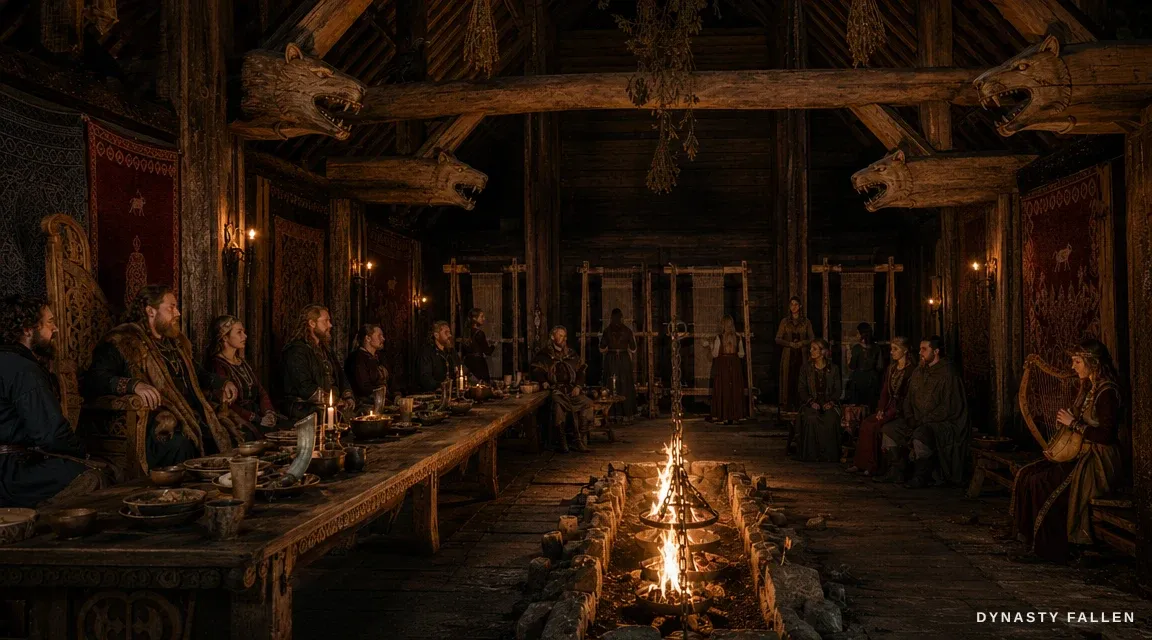
Snorri Sturluson’s Heimskringla gives Gunnhild and Erik’s union briefly: she rides south with his men, becomes his queen, and the saga moves on to the war of succession with Erik’s half-brothers. The narrative compression of the medieval source becomes the album’s invitation — the track fills in the saga’s silence with a silent-recognition register that the saga itself implies. Erik chose her and kept her against the political opposition of his court; she remained partnered with him through his exile and his two reigns at Jórvík until his death at Stainmore. The wedding at Harald Fairhair’s hall is the album’s only mutual-recognition scene — every other Gunnhild scene is at distance, through curse, through the witch’s strategic-surface arrangement of the world.
What’s documented is narrower than the dramatised feast. A queen named Gunnhild was the wife of Erik Bloodaxe and the mother of the Eríkssynir; the marriage was, by all source traditions, foundational to the Norwegian succession crisis that defines the second half of the tenth century. The album’s silent-recognition framing is its own — the saga gives Erik’s choice of her as fact and the partnership as fact, but does not give us interior thought. The track renders the recognition as it could plausibly have been read in the silence.
The bridge stages the album’s secondary thesis in its first form: “He took me for a witch, I took him for a king, / And neither one of us was wrong.” Erik called her witch and she did not deny it; the chroniclers called her witch and the album still does not deny it. The defense is not that she wasn’t a witch — it’s that calling her witch was never wrong. Track 08’s closer lands the line as final claim: “They never called me wrong.”
Documented core, sagaic interior. The marriage and Erik’s choice of Gunnhild are documented across multiple medieval source traditions (Snorri, Ágrip, Fagrskinna); the silent-recognition register the track stages is the album’s reading of the saga’s compressed narrative, not the saga’s own claim. The arm-ring and the morning-gift (mundr and morgengjǫf) are period-correct Norse wedding objects.