v.

I Named the Arrow

Act II — Mother of Kings Released Approx. 5:10
Verse 1
Two seiðr-chant lines in Old Norse breath, low and dry, then the full band drops in stomping — double-kick locked, war drums, tremolo guitars.

He did not see the witch in her hall,
He did not see the wind on his field,
He simply turned — and the arrow came home,
The men of my sons on the Fitjar shore,
The king on the rise, his weather-cloak black,
A name on my tongue, a thread on my loom,

Pre-Chorus
Tightening — jaw harp drone, palm-muted guitars climbing.

The wind at his back, the wind at his arm,
The bone of my flute, the breath of the curse,

Chorus
Stomping full band, war drums pounding, double-kick locked, women's chorus.

I named the arrow, I named the man,
I named the wound where the king would die,
Six sons, six blades, the throne is theirs,
Mother of Kings, the field is mine.

Verse 2
Sung stomping with a brief blast-beat burst on the arrow-rising lines, palm-muted guitars galloping, war drums, tagelharpa low-drone counter-melody.

The arrow rose, the rare-arrow rose,
Under the arm where no mail can hold,
Hákon the Good went white on the field,
He rode to the stone that would bear his name,

Pre-Chorus 2
Thickening — jaw harp louder, war drums, tagelharpa escalating.

The wind at his side, the wind in his lung,
The bone of my flute, the death of the king,

Chorus 2
Stomping full band, war drums pounding, lead-guitar harmony, women's chorus louder, double-kick locked. The third and fourth lines mutate.

I named the arrow, I named the wound,
I named the stone where the king would lie,
Six sons, six blades, the throne is theirs,
Mother of Kings, the shore is mine.

Bridge
Drums drop to a half-tempo stomp — not silence. Bone-flute solo over the jaw-harp drone, mezzo low chest, women's chorus underneath. The valbǫst named directly.

A rare arrow, valbǫst,
Under his arm,
Through the mail,
Into the lung,
He rode to the rock that bears his name,
And the rock will bear it long.

Guitar Solo
16 bars, lead guitar over a tagelharpa counterpoint, roughly 24 seconds, war drums pounding underneath.
Final Chorus
Biggest stomp — full band, war drums pounding, lead guitar holding, women's chorus locked, lurr war-horn hits. Closes on the six-line thesis.

I named the arrow, I named the man,
I named the wound where the king would die,
Six sons, six blades, the throne is theirs,
Mother of Kings, the world is mine,
And the good king died,
At the stone of his good name.

Outro
Drums hold one beat, bone flute fading, hard cut.

She did not ride to the field.
The arrow went, by her hand.

The history

<em>c.</em> 961 · the Battle of Fitjar on the island of Stord, western Norway · Gunnhild inland at her loom, naming the arrow that kills Haakon the Good

Source: Heimskringla — Hákonar saga góða (Snorri Sturluson, c. 1230, ch. 31–32); Fagrskinna (c. 1220); skaldic verses on the Eríkssynir (tenth century)

Named figures

  • Gunnhildr konungamóðir (G2, mid-30s) The witch-queen far inland at her warp-weighted loom; the album’s distant-causation hero scene. She does not ride to Fitjar — she names the arrow, the wound, and the stone from her hall, and the kill arrives at the shore by her hand
  • Haakon the Good (Hákon Aðalsteinsfóstri) King of Norway, Erik’s half-brother, raised at the English court of Æthelstan. Wins the field at Fitjar but takes the valbǫst under his raised arm where the mail-byrnie gaps; bleeds out on the ride north and dies at the rock since called Hákonarhella
  • Harald Greycloak (Haraldr gráfeldr) Eldest of the Eríkssynir, leading his brothers’ war of return; the throne passes to him after Fitjar and Gunnhild rules Norway through him for nearly a decade
  • Eyvindr Skáldaspillir The bowman the saga names as the one who loosed the rare arrow that struck the king — the human hand the album reads as guided by Gunnhild’s naming
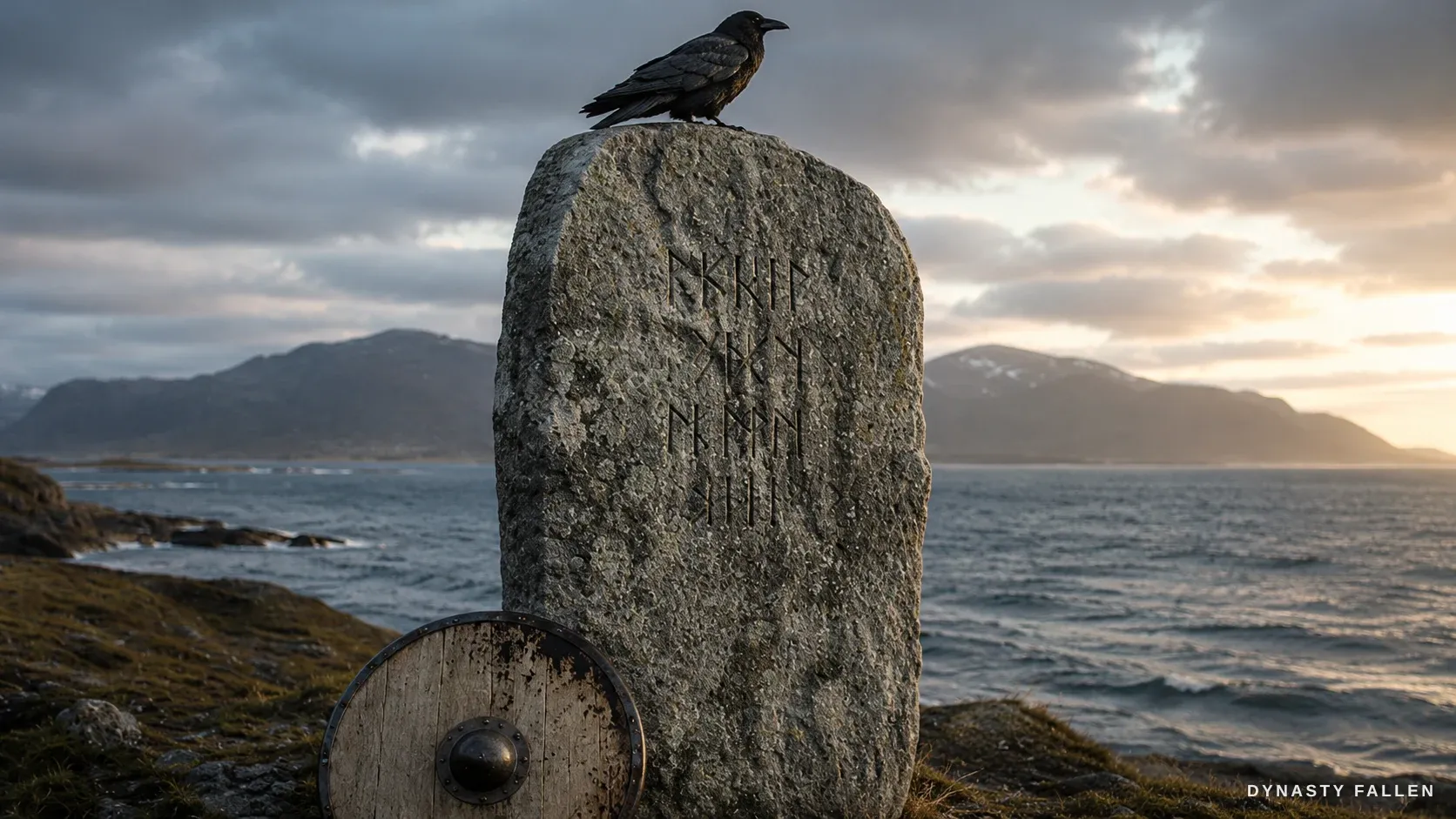
The Håkonarhella stone on the Norwegian coast, near where Haakon the Good fell.

What this song renders

The death of Haakon the Good at Fitjar is the most concretely-detailed kill in the whole album, and the detail is the saga’s, not the album’s. Heimskringla specifies the valbǫst — a rare or distinguished arrow — striking the king under the arm where the sleeveless mail-byrnie left him open, names the bowman, and follows the dying king north to the rock on the Norwegian coast that still bears his name, Hákonarhella. Haakon won the battle and lost his life; the throne passed to the Eríkssynir, and Gunnhild ruled Norway through her son Harald Greycloak for close to a decade. All of that is in the political record.

What the album adds is the cursing-mother point of view, and even that has a saga footing: Snorri reports, in the ‘men said’ register he uses for things he will not vouch for, that Gunnhild’s seiðr had named the arrow before it flew. The album commits to what the chronicler only repeats — it stages Gunnhild at the loom, naming the arrow, the wound, and the stone, while the men fight a battle she never reaches. This is the distant-causation hero scene the catalogue first ran with Sigrid at Svolder; the difference here is that Gunnhild is emphatically on-camera, acting, rather than absent.

The chorus’s closing line widens with each pass — the field, the shore, the world — tracking the cursing-act from one battle to the whole arc of the Eríkssynir’s reign. The outro withholds the engine and hard-cuts on the thesis the saga leaves implied and the album makes explicit: she did not ride to the field; the arrow went, by her hand.

Verdict

Documented kill, sagaic cause. The valbǫst, the under-the-arm wound, the bowman, and Haakon’s death at Hákonarhella are all specified in Heimskringla; the battle and the succession are firm political history. That Gunnhild’s seiðr named the arrow is reported by Snorri only as something ‘men said’ — the album promotes that hearsay to its organising claim, which is the witch-queen reading, not the chronicle’s verdict.

See the full Truth, Saga & Legend entry