What this song renders
Erik’s death at Stainmore is documented. The Anglo-Saxon Chronicle records the end of his Northumbrian kingship; Flores Historiarum, drawing on earlier Northumbrian sources, names Maccus son of Anlaf as the man who killed him in 954; the Norse sagas (Heimskringla, Fagrskinna) name Stainmore as the place where he fell. The saga sources disagree on the manner of death — Fagrskinna leans toward ambush, Heimskringla toward a last stand — and the album takes the ambush-by-treachery framing as the more dramatic and the more defensible for the Pennine terrain.
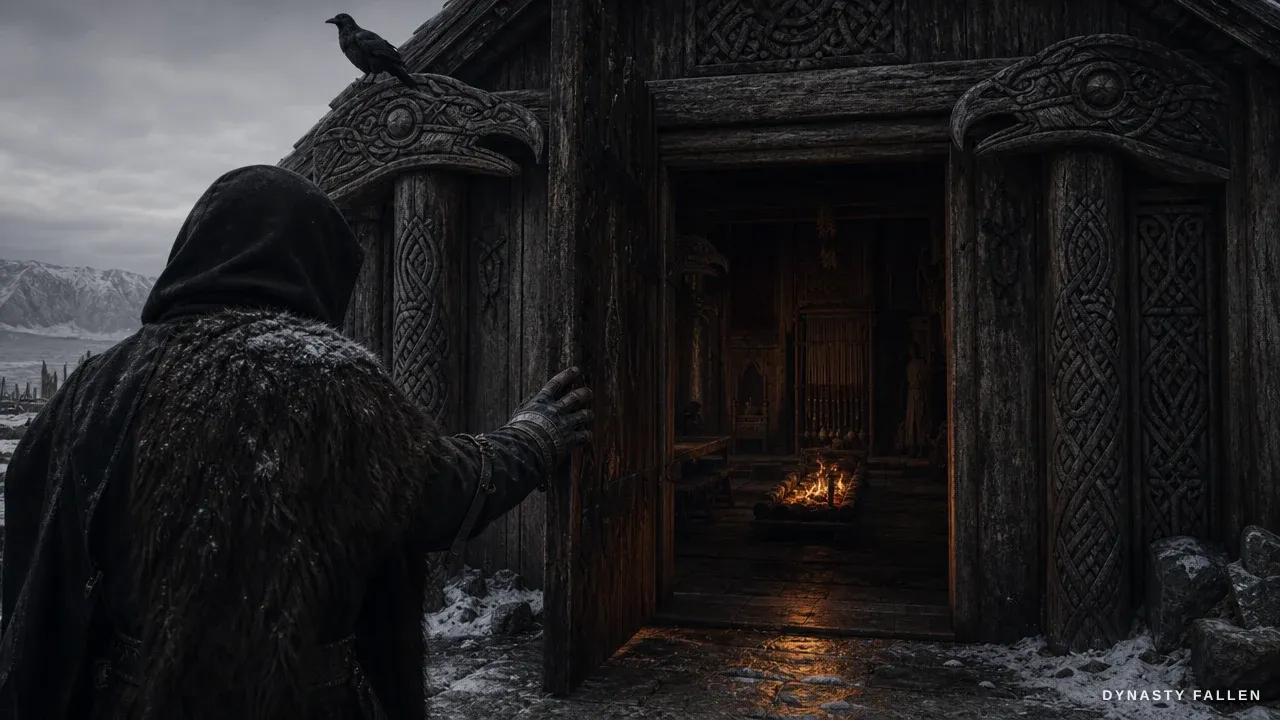
What the track stages around the documented death is the witch-queen’s response. The sagas do not record any journey by Gunnhild to recover or bury Erik, and the album’s central claim is that her answer to his death is the cursing, not the funeral — the leather pouch opened at the hearth, the ash dropped on the fire, the flame flaring up and not dying, the wind sent back across the sea. This is the album’s signature curse-shape, landing here for the first time before the named arrow at Fitjar (Track 05) and the bog at Haraldskær (Track 08). The witch’s refusal to weep or to name the dead aloud (“I did not weep, I did not name”) inverts the Norse public-mourning rite of keening and naming.
The chorus’s fourth line escalates across its three passes — the ash held as private mourning, then the cursing extending to ‘the next’ (Hákon the Good, the named arrow at Fitjar), then to ‘the war’ (the whole arc of the Eríkssynir’s return). The outro’s archaic verb ‘kept’ (“the moor kept his body. And the hearth kept mine”) plants the album’s tense-arc, the past-stasis grammar of places that hold what was given to them, which closes the record at the bog in Track 08.
Documented death, sagaic cursing. Erik’s killing at Stainmore in 954 is recorded in English source and Norse saga alike, with Maccus son of Anlaf named as the killer in Flores Historiarum. Gunnhild’s cursing-act at the hearth, her refusal of the funeral, and the ‘calling the wind back’ register are the album’s reading of the witch-queen frame, not the chronicles’ claim — though the chroniclers’ own dismissal of her as ‘widowed and gone’ is exactly the framing the track sets out to contest.