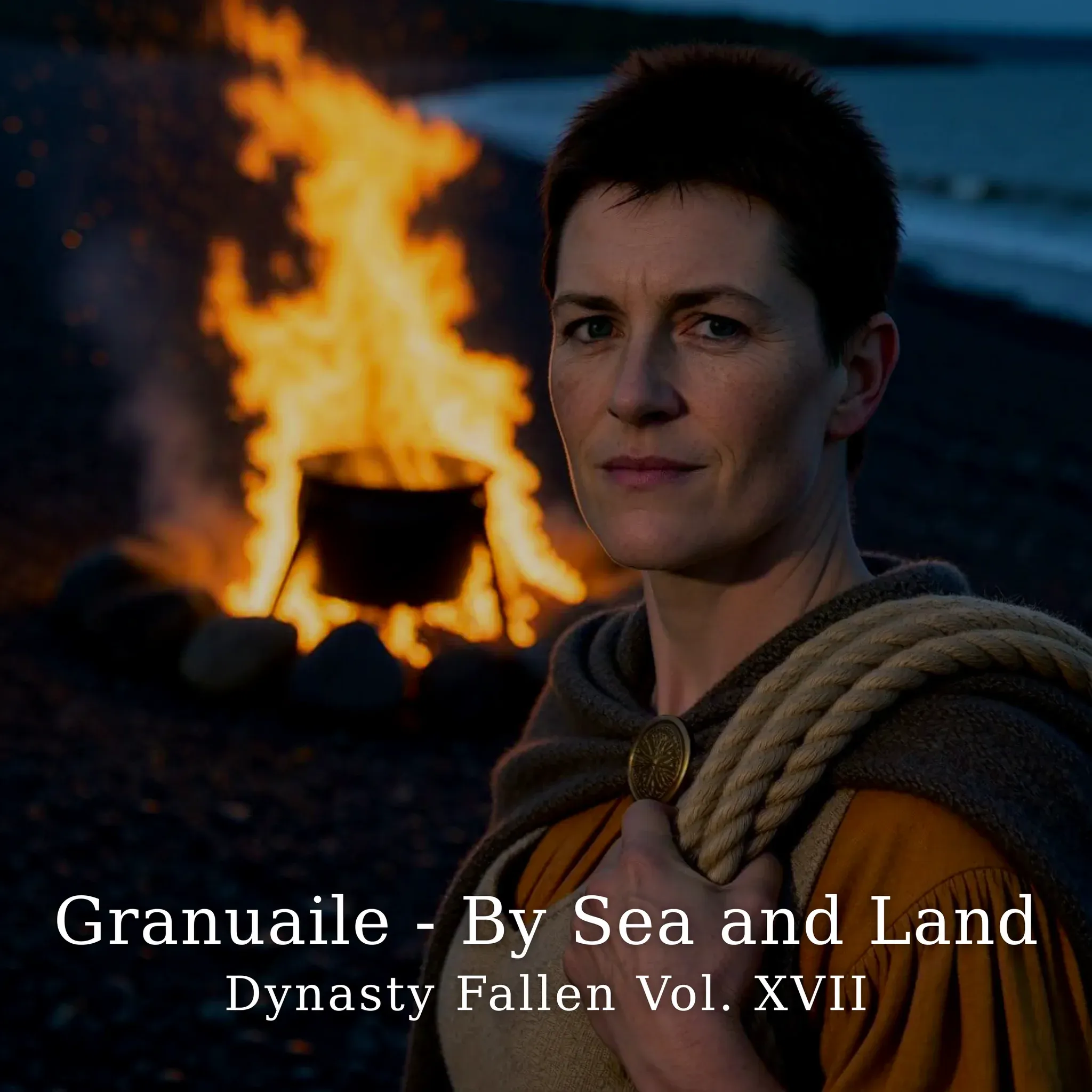
Dynasty Fallen · Vol. XVII

Granuaile
by sea and land

By sea and land. The pirate queen of Connacht. The woman who would not curtsey.
I won every fight I was in. I lost the world.

The story

c. 1530 – 1603
Clew Bay, Mayo, and the Irish Atlantic
Gaelic Ireland in the last years before the conquest

Gráinne Ní Mháille — Grace O’Malley, Granuaile — was born around 1530 into Clan Ó Máille of Umhall, a seafaring lordship on Clew Bay whose motto was terra marique potens, powerful by land and sea. Widowed in her thirties and denied the widow’s third that was hers by Gaelic law, she took two hundred of her dead husband’s followers back to O’Malley water and built something no woman in Ireland was supposed to have: a standing sea-lordship, run out of Clare Island and Rockfleet on three galleys, levying toll on every hull that crossed her coast for forty years.

The record that kept her is the record that wanted her hanged. She is effectively absent from the Irish annals; her own clan’s bardic memory did not survive. What survives instead is English paperwork — Sir Henry Sidney noting her arrival in 1577 “with three gallyes and two hundred fightinge men,” Sir Richard Bingham filing her as “nurse to all rebellions in the province for this forty years,” Lord Burghley’s eighteen numbered questions, and her own petition taken down by a clerk. So this album’s antagonist is not a swordsman. It is a document, and a patient man at a desk with ink on the first two fingers of his right hand.

Vol. XVII runs in three acts. What They Left Me is the dispossession and the sea-lordship built out of it. The Man at the Desk is the war of attrition against Bingham — the son taken from his own house and killed, the eighteen hanged, the four thousand cattle driven off the strand while the pen is still moving. Two Queens, One Face is Greenwich, September 1593: a sixty-three-year-old woman who sailed there herself, answered eighteen written interrogatories, walked onto a polished Tudor floor in Gaelic dress, and did not curtsey — and went home with her son released, her lands restored, and written royal permission to keep doing exactly what she had been doing.

“I won every fight I was in. I lost the world.”

She died around 1603, the year Elizabeth died and the Gaelic order ended. Her son, born at sea in the middle of a fight, was made an English viscount. That is the album’s argument: she was never beaten, she was annexed — and the loss the closer mourns is not hers, it is the world’s.

Album in active production. 4 of 4 tracks released.

Music videos

Out now.

The album opens on a widow who has been left nothing that floats, and two hundred of her dead husband's men who follow her anyway. It resolves on a bright cold room at Greenwich, where two old women stand facing each other and neither one bows.

ii. Three Galleys and Two Hundred Men Lyrics →

Track list

Four tracks. Three acts.

Three acts: the dispossession and the sea-lordship she builds out of it; the long war of attrition against one English governor with a good hand and an inkhorn; and the parley — eighteen written questions, one audience, and everything she came for.

Questions

About Granuaile.

The short answers — with links into the lyrics and the annotated history where the record gets interesting.

Who was Granuaile — Grace O'Malley?
Gráinne Ní Mháille (c. 1530 – c. 1603), anglicised Grace O'Malley and known in Irish tradition as Gráinne Mhaol or Granuaile, was a chieftain's daughter of Clan Ó Máille on Clew Bay in west Co. Mayo, and for roughly forty years the ruling sea-power of the Irish Atlantic coast. Widowed in her thirties and left with nothing that floated, she took two hundred of her dead husband's followers back to O'Malley water, ran galleys out of Clare Island and Rockfleet, and levied toll on shipping across the Mayo coast. Dynasty Fallen Vol. XVII tells her life across eight tracks.
Was Grace O'Malley really a pirate?
She was a sea-lord who taxed the sea she controlled, which the English administration recorded as piracy because it was not their tax. Her galleys were clinker-built, shallow-draught, up to thirty oars under a single sail, and they levied toll on hulls crossing her water, escorted those that paid, and raided those that did not — as far as Munster and, in tradition, Scotland. Sir Henry Sidney set her down in 1577 as arriving to meet him “with three gallyes and two hundred fightinge men.” By her own account, given to Elizabeth's officials, forty years of it was self-defence.
Did Grace O'Malley really meet Elizabeth I?
Yes, and it is the best-documented thing about her. In 1593, with one son murdered by the governor of Connacht and another gaoled, she petitioned the Queen directly. Lord Burghley first put eighteen written Articles of Interrogatory to her — on her family, her marriages, and the rights of women under Gaelic law — which she answered guardedly. The two women met at Greenwich Palace in September 1593. Elizabeth ordered her surviving son released, Bingham restrained, and maintenance found for her. She came home with what she asked for.
What date did they meet at Greenwich?
No day is securely attested. A 6 September 1593 date circulates widely in popular and “on this day” sources, but her biographer Anne Chambers says only “late summer 1593” and other reference works say “early September.” The month is solid; the day is not, so we don't print one. Note also that Ireland and England were on the Julian calendar throughout — every date attached to this album is Old Style.
Who was Richard Bingham, and what did he do to her?
Sir Richard Bingham was appointed governor of Connacht in 1584, and he is the album's antagonist — not as a monster, but as a competent administrator with a good hand and an inkhorn. He called her “nurse to all rebellions in the province for this forty years.” In 1586 her eldest son Owen O'Flaherty was taken from his own house under protection and killed; eighteen of her people were hanged, and four thousand head of cattle driven off. He later gaoled her surviving son Tibbot. The violence on this record is administrative, which is what makes it frightening.
Why is she missing from the Irish annals?
She is, almost entirely — and it is the historiographical engine of the whole album. The Gaelic annals and her own clan's bardic record either never set her down or did not survive. Practically everything documented about Granuaile comes from English state papers written by men trying to hang her: Sidney's memoir, Bingham's correspondence, Burghley's interrogatories, and her own petition, taken down by a clerk from her dictation. The only voice that kept her is the voice that wanted her dead.
Is the story about her cutting her hair true?
It is tradition, not record. The by-name Gráinne Mhaol — “bald” or “cropped” Gráinne — is popularly explained by a story in which she cut her hair short as a girl so she could go to sea with her father. The story is oral tradition only, and competing etymologies (Gráinne of Umhall; Granuaile as a run-together of Gráinne Ní Mháille) are at least as likely. The album keeps the crop as a visual claim and flags the origin story as legend.
Is there a real portrait of Grace O'Malley?
No contemporary portrait of her exists. The familiar image — the one reproduced almost everywhere — is an engraving published in the Anthologia Hibernica in 1793, roughly two centuries after her death, by someone who never saw her. Neither is the canopied tomb at Clare Island proven to be hers; the attribution is traditional. See the Truth & Legend page.
How did it end for her?
She died around 1603, most likely at Rockfleet — the same year Elizabeth died and the Gaelic order in Ireland ended. Her son Tibbot na Long, born by tradition aboard ship during a fight, was knighted in 1604 and created 1st Viscount Mayo in 1627. That is the album's closing argument: she was not defeated, she was absorbed. She won every round, and the family survived by being converted into the thing she had fought.

Where to listen

New tracks drop through the cycle.

Stream the album on your service of choice. Music videos go up on YouTube.