v.

Bare Blade

Act II — Vinland Released Approx. 4:20
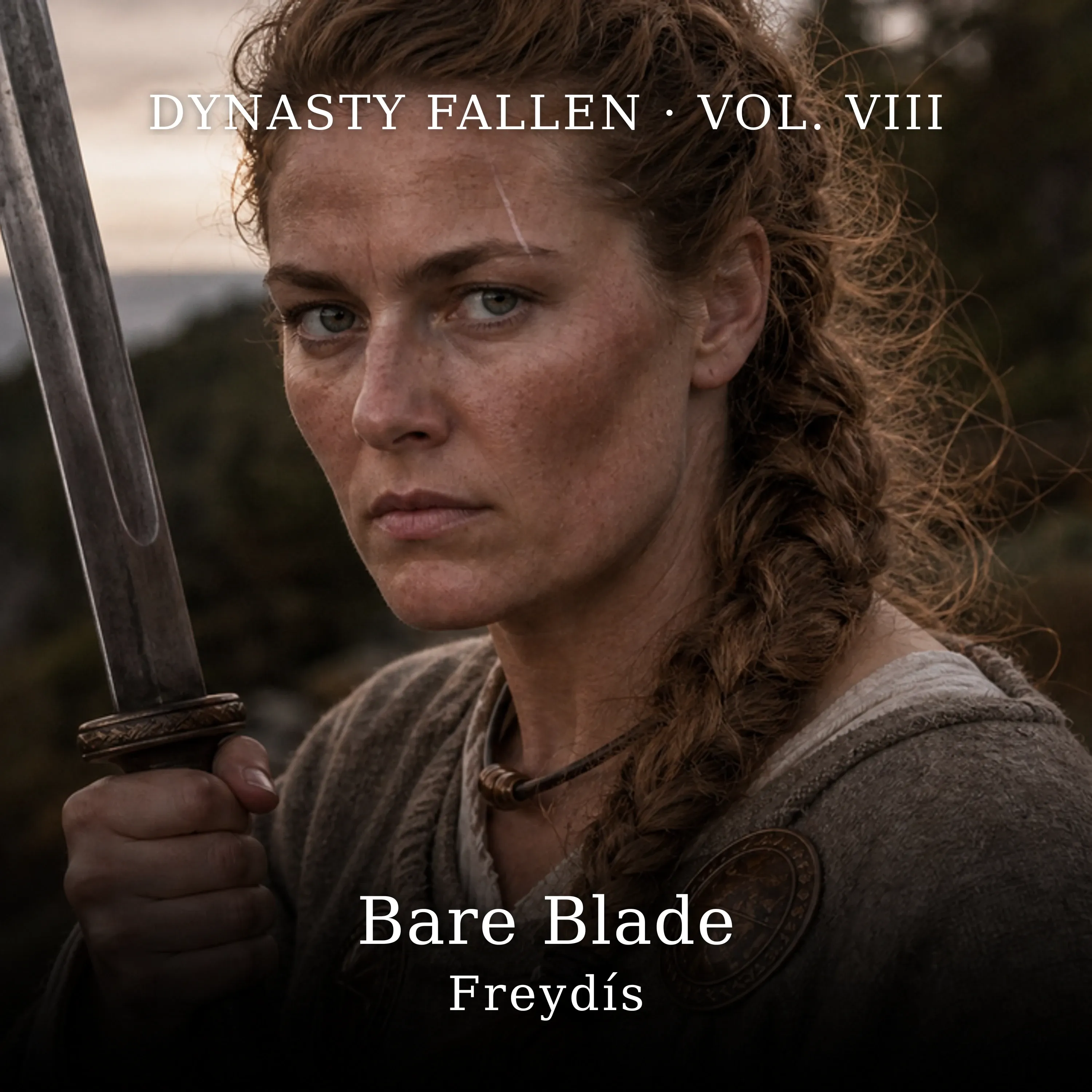
Bare Blade — track key art. Freydís at the Hóp clearing in golden-hour-to-dusk light, eight months pregnant, the 10th-century iron sword bared in her hand, dark strawberry-blonde warrior braid, the torn linen shift held at her shoulder, grey-green eyes locked forward, the Skrælingar treeline in cool shadow beyond her and the watch-fire’s warm glow at the camp edge. The Cinzel Medium wordmark reads ‘Bare Blade’ over ‘Freydís’ with the top banner ‘Dynasty Fallen · Vol. VIII’.
Verse 1
Two lines spoken low with an Old Norse breath, dry and reportorial, over heavy tribal frame drums, pounding war drums and palm-muted galloping electric guitar from the first beat. Then the verse lands sung and stomping — full band, double-kick locked, twin guitars, bouzouki under, bowed-lyre cold counter-line.

They did not stand,
They did not turn,
They simply ran, and she did not,
The longship gone, the men in the brake,
The Skrælingar at the treeline again,
Eight months in her belly, the men in flight,
A fallen sword, beside a dead Northman,

Pre-Chorus
Tightening — war drums at a gallop, palm-muted guitars climbing, bouzouki ascending.

The men ran north, the trees ran south,
Blood on the grass, a Northman's, not hers,

Chorus
Stomping full band — war drums pounding, double-kick locked, twin guitars, women's chorus locked carrying the first-person destiny voice.

Bare the blade, I bared the breast,
Slap and scream, and the world ran west,
Eight months mine, the iron is mine,
Erik's daughter, and the rout is mine.

Verse 2
Sung stomping — palm-muted galloping guitars, war drums, bouzouki under, bowed-lyre counter. The action sequence, verb by verb.

She lifted the iron from a dead man's grip,
She drew it once and let it weigh,
She tore her shift, she bared the breast,
She slapped the flat against the skin, and screamed,

Pre-Chorus 2
Thickening — double-kick under, war drums, bouzouki escalating.

The men ran south, the trees stood still,
Blood on the grass, the iron in her hand,

Chorus 2
Stomping full band — war drums pounding, lead guitar harmony, women's chorus louder, double-kick locked.

Bare the blade, I bared the skin,
Flat of the iron, the world fell in,
Eight months mine, the iron is mine,
Erik's daughter, and the camp is mine.

Bridge
Drums at half-tempo stomp — slowed but still pounding, never dropped. Soaring lead guitar, soprano lift, women's chorus underneath.

Eight months in her belly,
The sword still mine,
The breast still bared,
The land, still mine,
She did not ask the men to stand,
She did not need them to.

Guitar Solo
Sixteen bars — soaring lead guitar over half-tempo stomping war drums. Roughly twenty-four seconds.
Final Chorus
The biggest stomp on the album — full band, war drums pounding, lead guitar holding, women's chorus locked, war-horn hits.

Bare the blade, I bared the skin,
Flat of the iron, the world fell in,
Eight months mine, the iron is mine,
Erik's daughter, and the world is mine,
And the Skrælingar saw,
What the Northmen did not.

Outro
Drums fade to a half-beat, bowed-lyre talharpa final phrase, hard cut to silence.

She did not need to run.
The saga, by other hands.

The history

Early eleventh century · the Hóp encampment, Vinland, c. 1010 · the bareblade, the bared breast, the slap, the scream, the rout

Source: Eiríks saga rauða, ch. 11 (Hauksbók, Skálholtsbók); the L’Anse aux Meadows excavations anchoring the Norse presence on the Vinland coast

Named figures

  • Freydís Eiríksdóttir Eight months pregnant at Hóp and abandoned by the fleeing Norse men; she picks up a fallen sword, bares her breast, slaps the flat of the blade against her skin and screams — the saga calls her conduct vasklega, “valiantly”
  • Thorbrandr Snorrason Norse crewman on the Karlsefni expedition, killed in the Skrælingar attack at Hóp; the sword Freydís lifts is his. Track 04 planted him silent at the camp — his death is the saga-named precondition of the bareblade
  • Þorfinnr Karlsefni Expedition leader; at Hóp the saga records his men in flight through the brake while Freydís turns — the track carries him in the fleeing collective
  • The Skrælingar The Norse term of record for the Indigenous peoples of the Vinland coast — ancestors of the Beothuk and/or the Mi’kmaq. The saga records they “took fright” at her shriek; the track’s reading is that they read her stance correctly — the Norse men did not
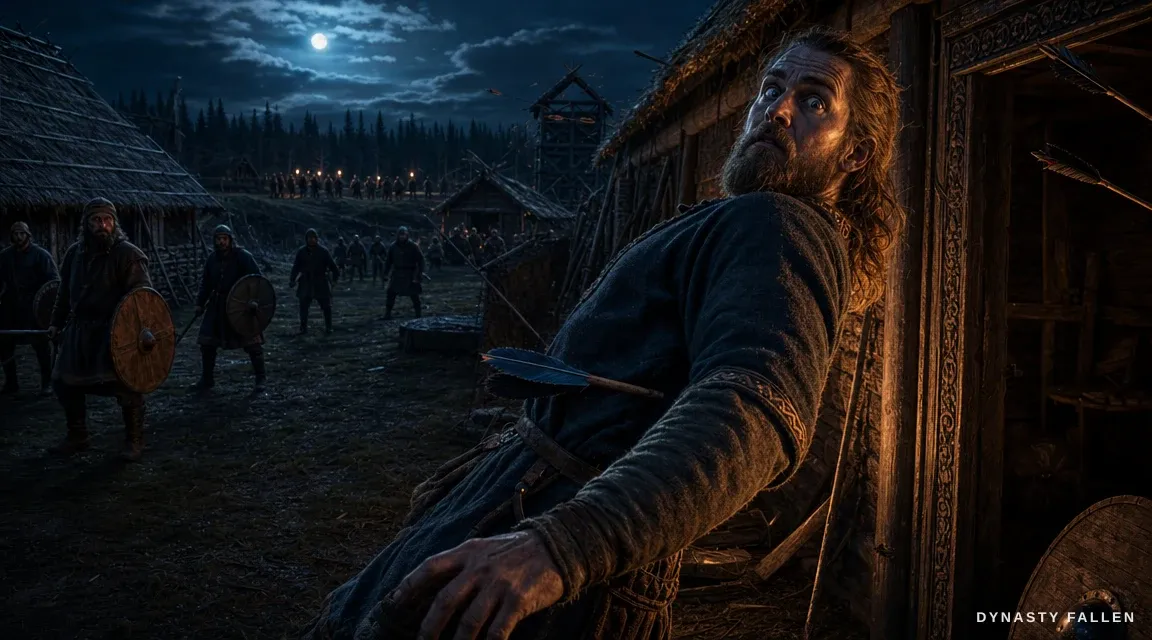
A Vinland camp under a volley of arrows at night — the Skrælingar attack Freydís turns at Hóp.

What this song renders

Eiríks saga rauða, chapter 11, records the sequence the track renders verb by verb. When the Skrælingar returned in force on the Karlsefni expedition’s camp at Hóp, the Norse men broke and fled for the brake. Freydís, eight months pregnant, could not keep their pace. In the clearing she came upon Thorbrandr Snorrason dead on the grass with his sword beside him; she lifted the iron, and as the attackers closed she pulled her shift from her breast and slapped the flat of the blade against her bared skin, screaming. The Skrælingar, the saga records, took fright and fled to their boats. The saga’s word for her conduct is vasklega — valiantly.

The track adds nothing to the account — its argument is in the framing. The negation chain of the cold open belongs to the men (they did not stand, they did not turn), and the Final Chorus couplet inverts the chronicler’s emphasis: the Skrælingar broke because they understood exactly what her stance said, while the Norse men had already misread the moment and run. The bridge completes the reversal — “she did not ask the men to stand / she did not need them to” — reframing abandonment as the saga’s own evidence that she was sufficient alone.

The rendering holds the album’s restraint protocols. The Skrælingar appear as the sagas’ term of record names them, rendered period-accurate to the pre-contact Maritime peoples — sealskin and caribou-hide, red ochre, birchbark canoes at the forest-edge — never the Plains-warrior trope. Blood stays on the grass at the dead Northman’s side, not on Freydís; the bareblade staging keeps the iron, not the body, as the subject of the frame.

Verdict

The bareblade is sagaic — it survives only in Eiríks saga rauða; Grœnlendinga saga records no Hóp stand, no pregnancy, no lifted sword. Within its saga the episode is unusually specific — the named dead man, the flat of the blade, the shriek, the rout, and the verdict vasklega — and the Norse presence in Vinland it sits inside is archaeologically documented at L’Anse aux Meadows. The album takes the account as one of its two truths; Track 07 renders the other.

Read the full Truth, Saga & Legend page