Truth, Saga
& Legend
What’s documented, what’s tradition, what’s storyteller’s flourish.
An annotated history of Elisiv.
The premise
Almost everything we know about Elisiv as a person comes from one source written roughly 165 years after she lived. The English record documents the catastrophe of 1066 with confidence; the contemporary skaldic verse documents the marriage and the king in fragments; but Elisiv herself survives almost entirely in Snorri Sturluson’s Heimskringla — and the kings’ sagas disagree with each other about the one thing the album most needs. This page tells you what the record gives us, what Snorri gives us, and the one thing the album gives itself.
The principal narrative source is Snorri Sturluson’s Heimskringla, written in Iceland around 1230 — roughly 165 years after the events. Snorri is the origin of nearly everything specific about Elisiv: the Orkney premise (that she, not Tora, waited there), Maria’s death in the same hour as her father’s, the arrow through Harald’s throat, his great height and mismatched brow, Eystein Orre’s last charge. It is a literary masterpiece and a late one — Snorri reconstructs scenes and speeches from older verse and tradition. Trust it for shape and for detail with a source behind it; hold its coincidences and its psychology loosely.
The contrasting record is earlier and harder. The Anglo-Saxon Chronicle (manuscripts C, D, E) and John of Worcester are near-contemporary English annals that document the campaign — the invasion at Tostig’s urging, the victory at Fulford, the catastrophe at Stamford Bridge on 25 September 1066 — with confidence. The skaldic layer is the most reliable of all: Stúfr the Blind, a contemporary court poet, documents the marriage; Harald’s own Gamanvísur are his surviving verses about the woman in Garðar who spurns him. And the Byzantine Strategikon of Kekaumenos knows ‘Araltes’ in imperial service — an independent Greek witness outside the Norse tradition entirely. The campaign and the king are documented; the woman is not.
The sharpest problem sits at the album’s own foundation. The older kings’-saga compilations — Morkinskinna and Fagrskinna, both c. 1220 and predating Snorri — say it was Tora Torbergsdatter, not Elisiv, who went to Orkney, and modern scholarship considers Tora the more likely candidate. The album’s entire stage therefore rests on the weaker, later of two competing accounts. That is a legitimate editorial choice, but it belongs in the saga column, openly, not in the documented one. It is the page’s most interesting claim, and we lead the saga section with it.
Verdicts below: Documented · From the sources · Legend & flourish.
Documented
What multiple independent sources agree on.Elisiv was a real Rus princess, daughter of Yaroslav the Wise, married to Harald Sigurdsson Hardrada.
This is the load-bearing fact the whole album hangs on, and it is documented — though it is worth being precise about how documented. The marriage, in the winter of 1043–44, is recorded by the contemporary court poet Stúfr the Blind (Stúfr inn blindi Þórðarson), not only by the later sagas. That makes it the single best-attested fact of Elisiv’s life: a verse composed within living memory, not a thirteenth-century reconstruction.
Her parentage is consistent across the Norse and Rus traditions — daughter of Yaroslav the Wise, grand prince of Kyiv, and his Swedish queen Ingegerd Olofsdotter. She belongs to one of the most successful dynastic-marriage webs of the eleventh century: her sisters Anastasia and Anne married into the royal houses of Hungary and France respectively, a network well documented on the continental side.
But “best documented” here means one contemporary skald and a lattice of marriages. There is no charter, no portrait, no Rus chronicle entry that names her, no record in her own voice. She is real, royal, and almost entirely silent — which is precisely the silence the album writes into.
Harald served in Kievan Rus under Yaroslav and in the Byzantine Varangian Guard, returning north with great wealth.
Harald’s years in the east are confirmed not only by the Norse sagas but — crucially — by a source entirely outside the Norse tradition. The Byzantine Kekaumenos, writing his Strategikon around 1075–78, knew of “Araltes,” the Norse prince who had served the empire and risen in its forces. A near-contemporary Greek witness, independent of Iceland and the sagas, is about as good as eleventh-century attestation gets.
He went first to Yaroslav’s Kyiv, then south to Constantinople and the Varangian Guard, campaigning in the Mediterranean and amassing a fortune that he sent north for safekeeping — to Yaroslav’s court, where Elisiv was. That southern gold is the engine of the album’s love story (the Gamanvísur, Track 01), and it is documented rather than invented. The man who would die at Stamford Bridge had already crossed the known world and come back rich enough to buy his way to a king’s daughter.
Harald composed the Gamanvísur — surviving verses about the woman in Garðar who spurns him.
The verses themselves are real and Harald’s. Sixteen stanzas survive in the kings’-saga corpus, each closing on the same refrain — the Gerðr (the goddess) of the gold ring in Garðar still spurns me — and they are edited as genuine eleventh-century skaldic poetry in the modern scholarly edition (Gade, Poetry from the Kings’ Sagas 2). The poems are documented; Track 01, The Girl in Garðar, takes its title and its frame from them.
What is not documented is the romance reading. That the spurning “Gerðr in Garðar” is Elisiv specifically, and that the refrain records genuine longing rather than a skaldic convention, is the saga’s interpretation laid over Harald’s words. As the consolidated source-critical note puts it, no implications about their actual affections can safely be drawn — the spurned-suitor pose may be a poetic cliché as much as a confession.
So the album uses the verses as bedrock and treats the love story as the warm gloss on them: the poems are his, the longing is the reading, and the page keeps the two apart.
Harald and Elisiv had two daughters, Maria and Ingegerd.
The two daughters are attested, and the attribution to Elisiv rather than to Harald’s later partner Tora is strengthened by a clean genealogical argument. Maria was betrothed to Eystein Orre, the brother of Tora Torbergsdatter. Had Maria been Tora’s daughter, Eystein would have been Maria’s uncle — and a betrothal between uncle and niece is ruled out. So Maria, and by extension her sister Ingegerd, are Elisiv’s daughters.
Ingegerd’s later career then anchors the whole family on documented ground: she became queen of Denmark and afterwards of Sweden (see claim 9). The daughters are not saga colour — they are the human stakes of the album, and they are in the record. Maria is the cost the album spends at the convergence (Track 07); Ingegerd is the survival the album closes on (Track 10).
Harald invaded England in 1066 at Tostig Godwinson's urging, won at Fulford, and fell at Stamford Bridge on 25 September 1066.
The campaign is the most securely documented thing in the album. The near-contemporary English annals — the Anglo-Saxon Chronicle in its C, D, and E recensions, and John of Worcester’s Chronicon — agree with the Norse sagas on the essential shape: the exiled Tostig Godwinson urged Harald to invade; the Norse won at Fulford on 20 September; and Harold Godwinson made a forced march north and caught them by surprise at Stamford Bridge on 25 September, where Harald Hardrada fell.
This is the one part of Elisiv’s story that rests on hostile, independent, near-contemporary testimony rather than on a single late saga. The English had no reason to flatter the invader and every reason to record the date precisely, and they did. Modern military history (DeVries) treats the campaign as firmly established; the disputes are about numbers and tactics, not about whether it happened. Everything the album builds on the other side of the sea — the sight, the convergence — is anchored to this hard, dated fact.
Harald was killed by an arrow to the throat; Tostig also fell; the Norse army was destroyed.
That Harald died and his army was annihilated is beyond dispute — the English and Norse sources agree, and Tostig fell in the same battle. The defeat is bedrock.
The vivid specifics, though, are Snorri’s. The detail that Harald took an arrow through the throat — struck because the Norse, marching to the bridge on a hot day, had left their mail byrnies back on the ships at Riccall — is Heimskringla’s account. It is plausible and it is single-source: exactly the kind of concrete, almost cinematic image a great saga writer reconstructs around a known outcome (a king is dead) and a remembered circumstance (it was hot, the armour was on the ships).
The album keeps the arrow, because it is the documented-feeling heart of the convergence (Track 07), and renders it through object and shadow rather than a clean wound. The page flags it honestly: the death is documented, the arrow-to-the-throat is Snorri’s framing of it.
A great fleet came — and only a fraction of its ships were needed to carry the survivors home.
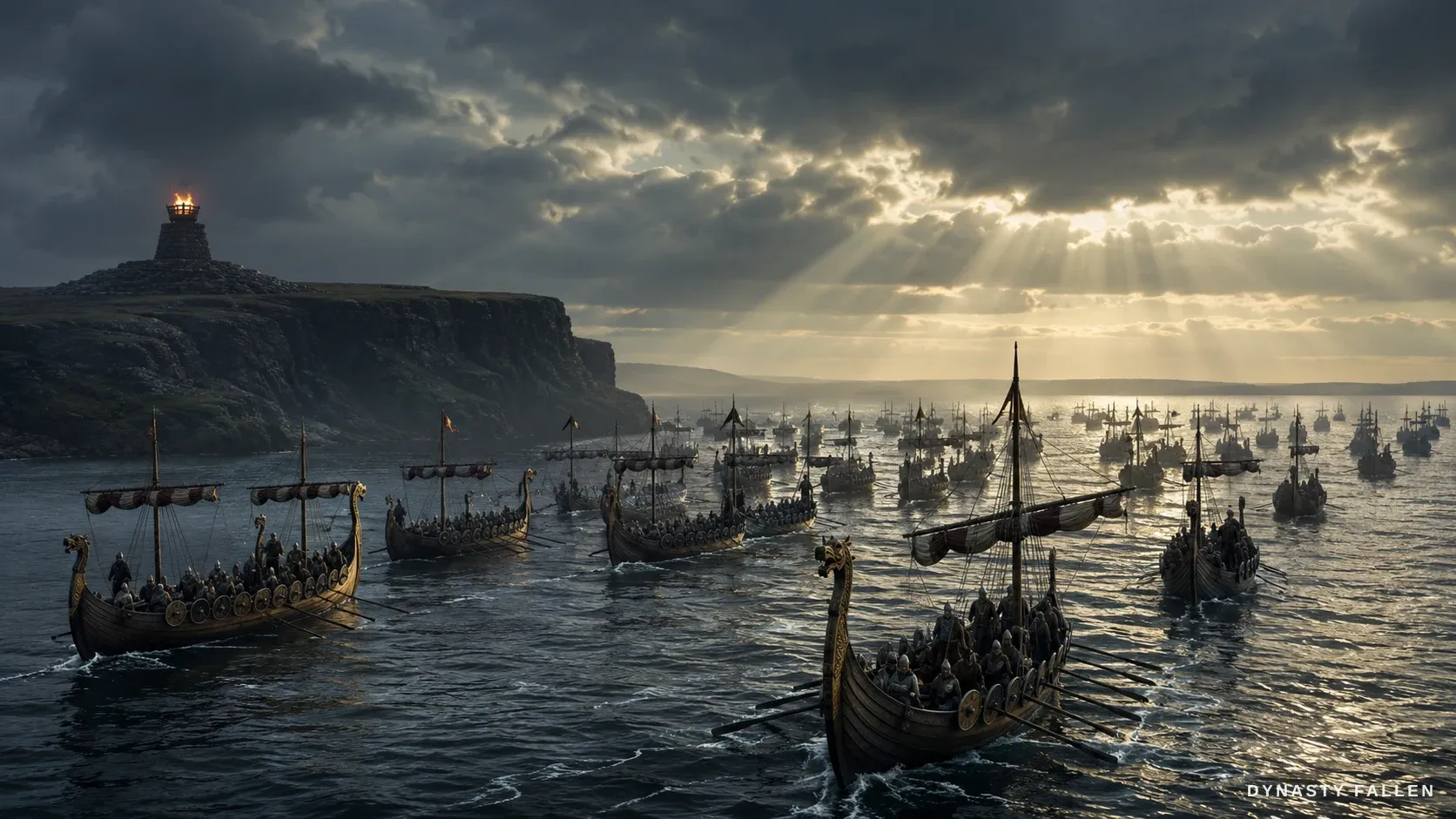
The scale of the catastrophe is documented, and it is the album’s load-bearing image (Track 03, Twenty-Four Ships). The Anglo-Saxon Chronicle gives the invasion fleet as 300 ships; Heimskringla says “over two hundred, besides supply ships.” The figure for the survivors who sailed home is far smaller — the saga’s twenty-four.
The magnitude is the truth here: an army that arrived in hundreds of hulls needed only a fraction of them to come home. That an invasion force could be reduced until a tenth of its ships sufficed to carry the living away is a real and devastating measure of what happened at Stamford Bridge, and it is attested.
The arithmetic, though, is not a literal casualty count — and the album is careful not to use it as one. Many of those ships were the guard left at Riccall that never fought, and the numbers come from different sources counting different things. That distinction is drawn out separately on the legend side (see the “300 out, 24 home” arithmetic): here, the documented claim is the scale of the loss, not a body count.
Olaf, ~16, was kept with the ships, survived, sailed the remnant home, and ruled Norway in a long peace.
Olaf Haraldsson — later Olaf Kyrre, “the Quiet” or “the Peaceful” — was about sixteen in 1066. He was kept back with the fleet at Riccall and did not fight at Stamford Bridge. He survived the catastrophe, sailed the broken remnant home, and went on to reign over Norway from roughly 1067 to 1093 in the longest stretch of peace of the entire Viking age, credited with founding the town of Bergen around 1070.
This matters to the album because the dynasty’s pivot from war to quiet is documented, not a theme the album imposes after the fact. The age really did end in a boy who never drew his blade and then ruled a generation without a major war. Track 09 puts him at the helm of the dead king’s ship; Track 10 makes his peace half of the album’s answer to its own elegy — and both rest on the record.
Ingegerd survived and became queen of Denmark, then of Sweden.
Ingegerd Haraldsdóttir (c. 1045 – c. 1120), Elisiv and Harald’s surviving daughter, married first Olaf Hunger — later king of Denmark — and afterwards Philip, later king of Sweden. The “blood survives in two crowns” note that closes the album (Track 10) is therefore on solid ground: the line that ran out at Stamford Bridge in the male, war-making sense continued through a daughter into two royal houses.
It is the documented counterweight to the album’s grief. The age ended; the bloodline did not. The closer can claim, without invention, that what the women carried outlasted what the men lost — Ingegerd wore the crowns of Denmark and Sweden, and Olaf Kyrre held Norway in peace, while the king who had crossed the world to win their mother lay under the English ground.
From the sagas
Mostly Heimskringla, and mostly Snorri alone. Plausible, vivid, and — for the album’s own stage — chosen over the older record.It was Elisiv — not Tora — who accompanied Harald to Orkney in 1066 and waited there while the fleet went south.

This is the album’s central, load-bearing saga claim, and it is also the one the catalogue’s whole editorial promise is built to handle: the album’s entire stage rests on the weaker, later of two competing accounts, and we are telling you so.
Heimskringla says Harald brought Elisiv and their daughters as far as Orkney and left them there before sailing for England. But the older kings’-saga compilations — Morkinskinna and Fagrskinna, both written around 1220, predating Snorri — say it was Tora Torbergsdatter, Harald’s other partner, who went to Orkney. And modern scholarship leans toward Tora, for a concrete reason: Tora was kin (a cousin) to Thorfinn Sigurdsson, Earl of Orkney, which gave Harald an obvious motive to leave her, and not the Rus queen, in the earl’s safekeeping.
So the album takes Snorri’s version against the balance of the evidence — and on purpose. Elisiv is the queen, the foreigner, the album’s whole lens; the story the album wants to tell cannot be told from Tora’s vantage. The cautious historian’s answer is “probably Tora, and we cannot be sure where Elisiv was at all.” The album’s answer is “Elisiv, on the headland, watching.” We have chosen the later source because it is the one that makes a woman the witness to the end of her husband’s age — and this page is the place we admit it. It is the sharpest claim on the page: the album’s stage is Snorri’s, not the record’s.
Maria died suddenly in Orkney on the very day — said to be the very hour — her father fell at Stamford Bridge.
This is the album’s centerpiece (Track 07, the convergence), and it is single-source. Maria’s death on 25 September 1066 is recorded; the simultaneity with her father’s death is Snorri’s. Heimskringla says she died suddenly the same day and hour that King Harald fell — the kind of perfect, devastating coincidence that has the shape of a story told backward from a known outcome.
It is unfalsifiable and almost certainly too neat. A daughter dying on the same day as her father is the sort of detail that a tradition, knowing both deaths, draws together into a single hour because the meaning is unbearable otherwise. The album builds its emotional peak on it precisely because it is unbearable — but the page names it as the saga’s gift rather than the record’s fact.
One detail matters for how the album renders it: the saga gives Maria no wound and no cause. She simply falls. The album preserves that exactly — no blood, no wound, no sound — and the page should note the saga’s own silence on how she died. The convergence is true to Snorri down to what Snorri declined to explain.
A lone Norseman held Stamford Bridge alone against the English army until he was speared from beneath.
The most famous image of the battle — a single Norse axeman holding the wooden span alone, cutting down all comers until an Englishman floats beneath the bridge in a half-barrel and spears him from below — is not in the original record. It does not appear in the contemporary entries of the Anglo-Saxon Chronicle at all.
It survives as an added folio in manuscript C, written in a late-twelfth-century hand — roughly a century after the battle. It may preserve genuine oral tradition that the original annalist simply omitted; it may be folklore that accreted to a famous defeat over a hundred years. There is no way to tell. Either way it is late, single-source, and unverifiable, and the celebrated man-in-a-barrel detail is exactly the kind of vivid mechanism that grows on a story in retelling.
The album renders the lone defender (Track 06, The Man on the Bridge) as the age’s last stand in one figure, because it is the perfect emblem for an age ending — one man on a bridge against everything coming. The page classifies it as saga rather than legend because it may carry real tradition, but the honest caveat is stated plainly: added a century later, and the barrel is the kind of thing stories grow.
Eystein Orre led the exhausted reinforcements in a doomed final charge — "Orre's storm."
The arrival of the Riccall reinforcements under Eystein Orre — and their doomed last attack, named Orra-hríð, “Orre’s storm,” in the saga — is Heimskringla’s account. The reinforcements running up from the ships in their armour on a hot day, arriving exhausted into a battle already lost, and charging anyway, is exactly the kind of named, dramatized set-piece Snorri excels at.
Eystein’s death is entirely consistent with the documented annihilation of the army; what is saga is the framing — the named storm, the heroic futility, the dramatic shape. It is plausible single-narrative rather than independently confirmed.
It earns its place in the album because of who Eystein was: Maria’s betrothed. The man she was to marry died in the same battle, on the same day, as her father — and Maria herself died that hour in Orkney. The album’s emotional symmetry, three deaths converging on one afternoon, is in the saga, and the page keeps it while naming it Snorri’s framing of a real defeat.
Harald stood nearly seven feet — "five ells" — with one eyebrow set higher than the other.
Snorri stresses Harald’s exceptional height and gives him a memorable, almost portrait-like asymmetry: one eyebrow sat higher than the other. The famous “five ells” figure — rendered as nearly seven feet — is saga superlative rather than measurement; an “ell” is a loose unit and the phrase is the kind of round, towering number sagas reach for when they mean this man was conspicuously huge, not a tailor’s record.
The mismatched brow is the more interesting detail, because it has the texture of something remembered rather than invented — the sort of specific, slightly unflattering feature that tends to survive because someone actually noticed it. But both come to us only through Heimskringla, two centuries on, and both are character-painting first.
The album renders Harald as conspicuously the tallest figure in any frame, with the uneven brow, and keeps him mostly at distance and three-quarter — saga flavour, deployed as flavour, and flagged here as such rather than offered as physical fact.
Legend & flourish
Where the record runs out — and the one thing the album invented.Elisiv had the second sight, and saw the battle across the sea as it happened.

This is the one thing on the page that is wholly ours, and we are proud to say so. There is no source — not Snorri, not the skalds, not the English annals — for Elisiv as a seer. The sight is the album’s deliberate invention: the device that lets a woman three hundred miles from Stamford Bridge narrate the battle, watch the arrow take her husband’s throat, and turn to find her daughter fallen in the same hour.
It is the catalogue’s first openly fictional anchor — an invented lens on a fully documented world, the Last Kingdom model, where the eye is made up but everything it sees is real. Every battle, death, ship-count, and named figure around the sight is in the record. The sight is the seam where the album stops reporting and starts imagining, and it is the only such seam in the whole work.
We flag it plainly and proudly rather than smuggling it in as half-history: the woman is real, the catastrophe is real, the grief is real, and the way she comes to know it — across the sea, before the ships could bring the word — is the album’s fiction. That honesty is the point of this entire page.
Elisiv returned to Norway and died within the year.
The album’s clean ending — she carried the meaning home and was gone within a year — is narrative tidying, not record. The date and place of Elisiv’s death are genuinely unknown. It is presumed she did not long outlive Harald, which is where the c. 1067 estimate comes from, but the sources simply lose her.
Worse for tidiness — and better for this page — the record is actually ambiguous about what became of her at all. Adam of Bremen reports that the mother of Olaf Kyrre remarried as a widow (to Sweyn II of Denmark, or to an unnamed Swedish king), and it is unclear whether that means Tora, who was Olaf’s actual mother, or Elisiv, his stepmother. So one reading even has her remarrying rather than dying in grief within the year.
The honest version is that she vanishes. The woman the entire album is about exits the historical record without a recorded death — no date, no place, possibly even no clean widowhood. The album chooses a death-within-a-year because an elegy needs an ending and the thesis line needs somewhere to land. It is a flourish laid over a blank, and the page would rather show you the blank.
Three hundred ships went out and twenty-four came home — read as a literal casualty count.
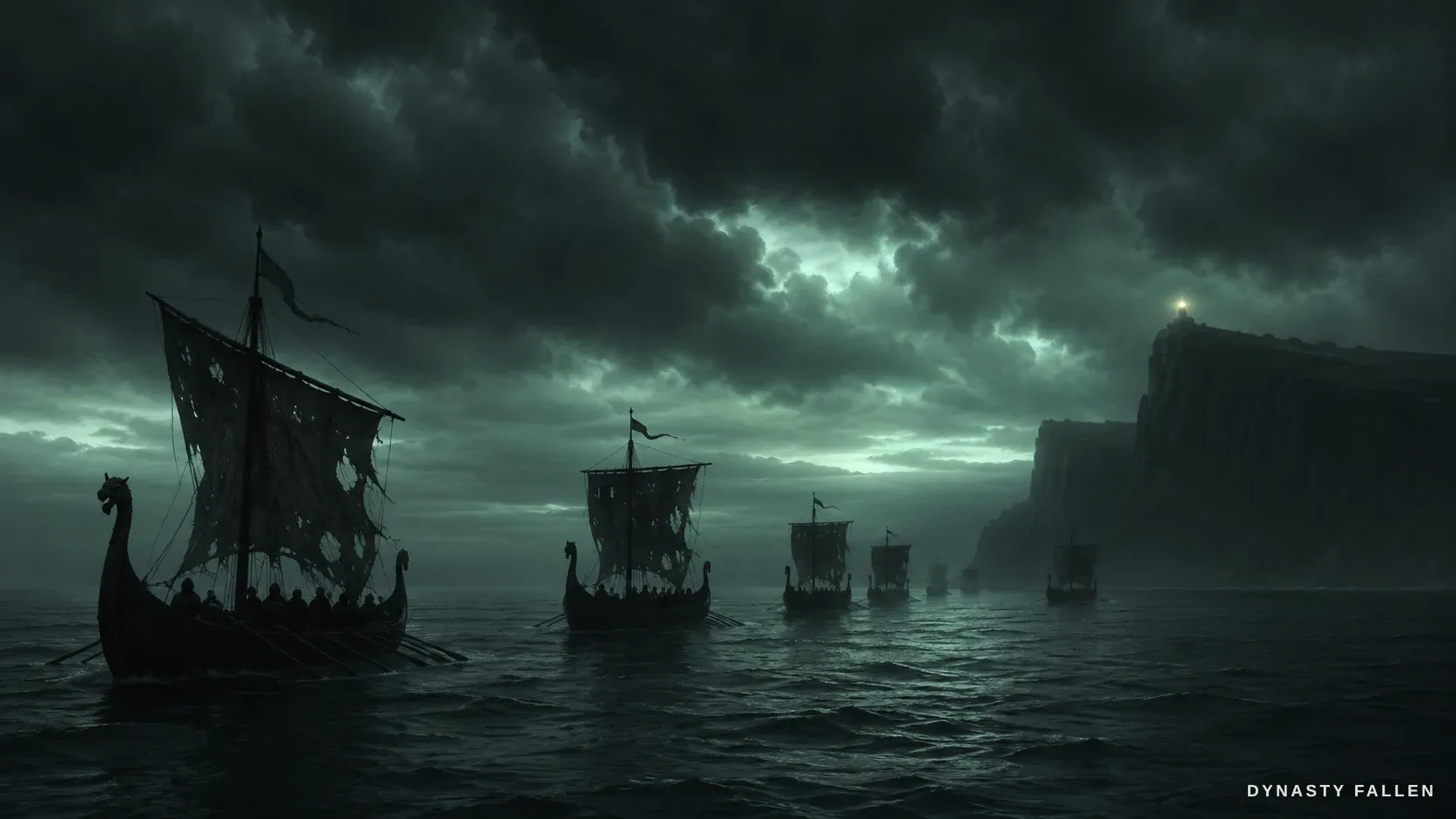
The scale of the disaster is documented and devastating (see the documented claim, A great fleet came). The literal arithmetic — that the gap between 300 ships out and 24 home represents roughly 276 shiploads of dead men — is not, and the album is careful never to use it that way.
Three things break the literal reading. First, the numbers come from different sources counting different things: the 300 is the English Chronicle’s figure for the invasion fleet, the “over two hundred” is Snorri’s, and the 24 is a saga figure for the survivors. Second, many of those ships were the Riccall guard — left with the fleet under Olaf, never committed to the battle, and entirely available to sail home. And third, “ships needed to carry the living” is not the same measure as “ships lost in combat”; a depleted army packs into fewer hulls.
So the famous contrast is true as an image and false as a sum. The album uses it exactly as an image — the unbearable shrinking of an armada to a handful of hulls (Track 03) — and this page draws the line the hook is careful not to cross: the scale is real, the body-count arithmetic is legend.
A note on stance
Why the album holds the position it does
The honest summary is three sentences long. The record gives us the catastrophe — the invasion, the bridge, the annihilated army, the twenty-four ships that carried the survivors home. Snorri gives us the woman — Elisiv on the headland, Maria falling beside her in the same hour. The album gives us the sight — the second sight that lets a woman three hundred miles from the battle narrate the battle, the catalogue’s first openly fictional lens on a fully documented world.
If you want the cautious historical Elisiv: she was a real Rus princess, daughter of Yaroslav the Wise, married to the last great Viking king, mother of two daughters, and she waited out the campaign of 1066 somewhere in the north — possibly Orkney, possibly not — and then she vanishes from the record without a recorded date or place of death. If you want the album’s Elisiv: she stood bare-headed on the Orkney headland with the sight on her, watched the arrow take Harald’s throat, and turned to find Maria fallen white-faced beside her in the same hour, three hundred miles from the bridge.
Vol. XII is for the woman at the age’s death, seen through a sight we invented and label as ours. Everything around the sight is in the record. The sight is the one thing that is not, and we are telling you so. This page is here so you can hold both at once.
Sources & further reading
What the album draws from, and modern scholarship for digging deeper.Primary sources
- Heimskringla — Haralds saga Sigurðarsonar (King Harald’s Saga)
The album’s principal narrative source and the origin of nearly everything specific about Elisiv: the Orkney premise, Maria’s same-hour death, the arrow to the throat, Harald’s height and brow, Orre’s storm. Written in Iceland ~165 years after the events from older verse and tradition. A masterpiece, and late — trust its shape, hold its coincidences loosely.
- Morkinskinna
The oldest of the continuous kings’-saga compilations, predating Snorri. Matters here because it (with Fagrskinna) is the witness for Tora, not Elisiv, in Orkney — the older record the album knowingly overrides.
- Fagrskinna
A terser kings’ synopsis, also earlier than Heimskringla. Corroborates the older Orkney tradition that puts Tora, not Elisiv, on the headland.
- The Anglo-Saxon Chronicle (MSS C, D, E)
The near-contemporary backbone of the 1066 campaign: the invasion, Fulford, Stamford Bridge, the scale of the fleet. Note that the famous lone defender of the bridge is not original — it is a late-twelfth-century addition to manuscript C, written a century after the battle.
- Chronicon ex chronicis
The fullest early English narrative of 1066. Corroborates the invasion, the victory at Fulford, and the catastrophe at Stamford Bridge independently of the Norse tradition.
- Skaldic verse — Stúfsdrápa, Þjóðólfr Arnórsson, and Harald’s own Gamanvísur
The most reliable layer. Stúfr the Blind documents the marriage; Þjóðólfr was Harald’s court poet through the reign and the campaign; the Gamanvísur are Harald’s own surviving verses about the woman in Garðar. Fragmentary and formulaic, but contemporary — the closest thing to a documented voice from inside the story.
- Strategikon
An independent, near-contemporary witness to ‘Araltes’ (Harald) in Byzantine service — outside the Norse tradition entirely, which is why it matters. Confirms the eastern wealth that is the engine of the album’s love story.
- Gesta Hammaburgensis Ecclesiae Pontificum
Near-contemporary. The source for the unresolved remarriage of ‘the mother of Olaf Kyrre’ — which may mean Tora (his actual mother) or Elisiv (his stepmother) — the ambiguity that leaves Elisiv’s end genuinely unknown.
- Orkneyinga saga
The saga of the Earls of Orkney. Context for Earl Thorfinn Sigurdsson and the kinship between Thorfinn and Tora that underlies the older Orkney tradition — the concrete reason scholarship leans toward Tora over Elisiv on the headland.
Modern scholarship
- The Norwegian Invasion of England in 1066
The standard modern military-historical study of Harald’s campaign. The best place to sort the documented campaign from the saga embellishments around it.
- King Harald’s Saga: Harald Hardradi of Norway
The standard accessible English excerpt of the Heimskringla material on Harald. The album’s working text for the saga narrative.
- Poetry from the Kings’ Sagas 2: From c. 1035 to c. 1300
The scholarly edition of the skaldic corpus, including the Gamanvísur and Stúfr’s verse — the place to cite the actual poems rather than the saga’s paraphrase of them.
- Morkinskinna
The English Morkinskinna. The older-tradition counterweight to Snorri, and the accessible witness for the Tora-in-Orkney reading.
- Medieval Russia, 980–1584
For the Kievan-Rus side: Yaroslav the Wise’s dynastic marriage diplomacy that placed Elisiv’s sisters on the thrones of France and Hungary, and Elisiv herself in Norway.
- Anglo-Saxon England
The standard reference for England in 1066 and for the relative value of the Chronicle manuscripts — including which details are contemporary and which are later additions.
- ‘Ellisiv,’ Norsk biografisk leksikon
The standard Norwegian biographical-encyclopedia treatment. Concise and clear-eyed on the source problems and on the genuinely unknown date and place of her death.
Read online
- The Skaldic Project (Skaldic Poetry of the Scandinavian Middle Ages)
The Gamanvísur and Stúfr’s verse with original text, translation, and apparatus — the documented poems behind the love story.
skaldic.org → - Heimskringla — Saga of Harald Hardrade (full English text)
The full saga narrative behind the album. Dated Victorian English, but free and complete.
sacred-texts.com → - ‘Ellisiv’ / ‘Tora Torbergsdatter,’ Store norske leksikon
The source-critical summary in brief, including the Tora-versus-Elisiv Orkney problem and the note that her death is unrecorded.
snl.no → - Battlefield Report: Stamford Bridge 1066
The documented battle, with the useful note that the C-manuscript lone-bridge-defender folio is a late addition rather than an original entry.
historicengland.org.uk → - Wikipedia — Elisiv of Kiev; Maria Haraldsdotter; Battle of Stamford Bridge
Navigational only. Useful for the consolidated source-critical notes — the Tora-versus-Elisiv problem and the unknown death — but cite the primary and modern works above for anything load-bearing.
en.wikipedia.org →
Citations on individual claims above point to specific chapters and editions. The list here is the broader context — what to read next if you want to follow the queen out of the song and into the historical record.