Dynasty Fallen · Vol. VII

Cleopatra
Vol. VII

The Serpent Queen. The last pharaoh. Isis incarnate.
Isis walked in me — and Rome will learn what that means. The album takes Egypt's record over Octavian's.

The story

First century BC
Egypt, Alexandria, the Nile
The last pharaoh against the Roman tide

Cleopatra VII Philopator (69–30 BC) was the last Ptolemaic ruler of Egypt and the first Ptolemy in three centuries to learn the Egyptian language. Plutarch reports she spoke nine — Egyptian, Greek, Latin, Hebrew, Aramaic, Arabic, Median, Parthian, Ethiopian. She inherited a kingdom bankrupted by her father’s tribute to Rome, took the throne at eighteen, was driven out by her brother-husband, smuggled herself back to Caesar in linen bedding (not a carpet — Plutarch’s word is strōmatodesmos), restored her throne, bore Caesar’s son Caesarion, married Mark Antony Egyptian-style, bore three more children, lost Actium, watched Antony die, and chose the asp rather than walk in Octavian’s triumph.

Every Cleopatra treatment in pop culture builds on Octavian’s record — the seductress, the foreign temptress, the danger Rome had to put down. The Roman tradition (Plutarch, Cassius Dio, Vergil, Horace) was state propaganda by the man who killed her. The Egyptian record is different. Her coins show her in pharaonic regalia. Her titles include Thea Neotera — the Younger Goddess. Her inscriptions at Philae and Dendera document her as Isis-on-earth. The Donations of Alexandria ceremony in 34 BC — attested by three independent hostile Roman sources, which means even the propaganda tradition can’t deny it happened — seated her enthroned as Isis with Caesarion as Horus and Antony as Osiris-Dionysus, distributing Roman-conquered territories to her divine children.

The album takes the Egyptian record over Octavian’s. Cleopatra wasn’t like Isis — she performed the goddess as state religion, and the historical evidence supports the claim more than the seductress-myth does. Vol. VII commits to that frame across ten tracks: the coronation, the goddess in the temple, the goddess on the barge at Tarsus, the goddess on the silver dais at the Donations, and the goddess in the mausoleum choosing the cobra of Lower Egypt as her final unification with the figure she had been embodying her whole reign.

The thesis line — Isis walks in me, and Rome will learn what that means — is the album’s spine. Planted in Track 01’s bridge, stated in Track 04’s, reclaimed in past tense at Actium, turned to divine grief in Track 09, and sealed in past-tense closure on Track 10. The arc is from claim to consequence: a queen who told Rome what she was, and a Rome that could not absorb the answer.

Album in active production. 10 of 10 tracks released.
The world of Cleopatra

Her story, place by place.

Drawn from the videos — each frame opens its track.

Music videos

Out now.

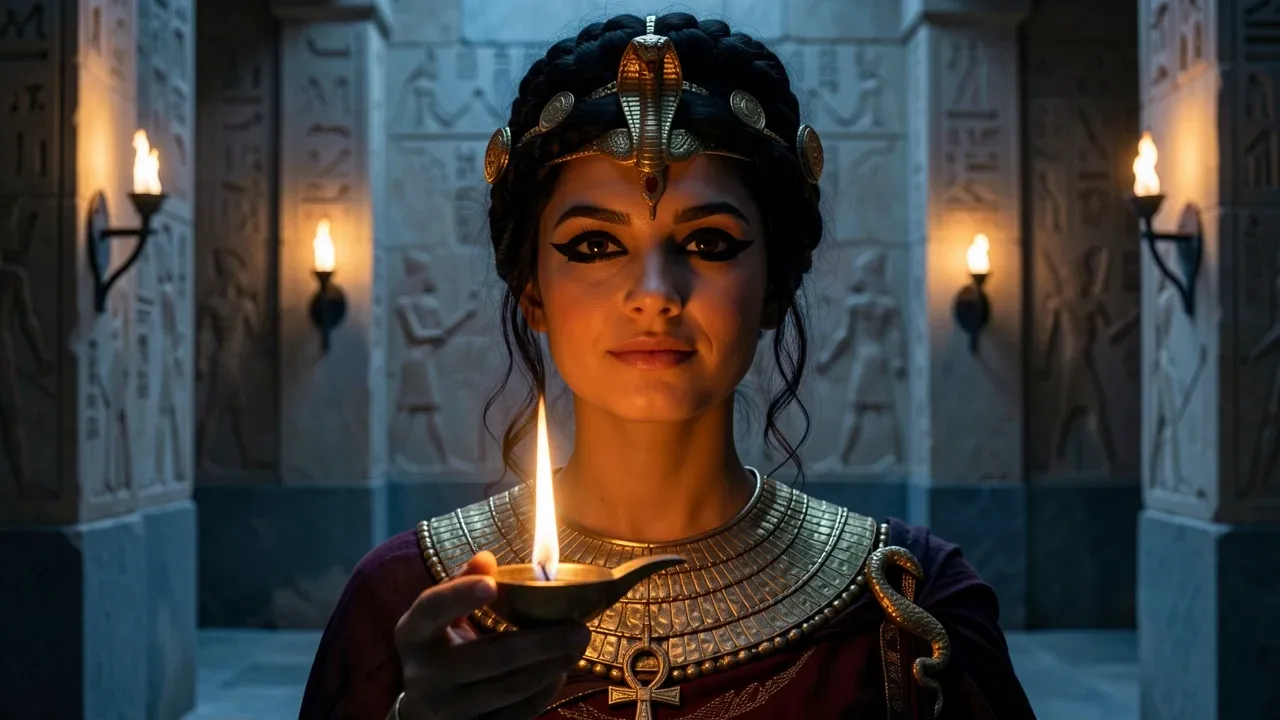
The first track opens on the heir-to-be — scholar at the Library, daughter of three thousand years of pharaohs, Uraeus set on her brow at eighteen. The album's thesis lands in the bridge: Isis walked before me — and I am next.

Track list

Ten tracks. Three acts.

Three acts: the coronation and the smuggling-to-Caesar; the goddess at full state-religion power; the war Octavian declared on a queen because Rome could not declare it on its own.

Questions

About Cleopatra.

The short answers — with links into the lyrics and the annotated history where the record gets interesting.

Who was Cleopatra VII?
Cleopatra VII Philopator (69–30 BC) was the last ruler of Ptolemaic Egypt and the last pharaoh of any dynasty. She took the throne at eighteen, allied with Julius Caesar and then Mark Antony, bore four royal children, ruled for more than two decades, and ended her life in 30 BC rather than be paraded through Rome by the future emperor Augustus. Dynasty Fallen Vol. VII tells her arc across ten tracks — not the Roman seductress but the queen who governed as the goddess Isis on earth.
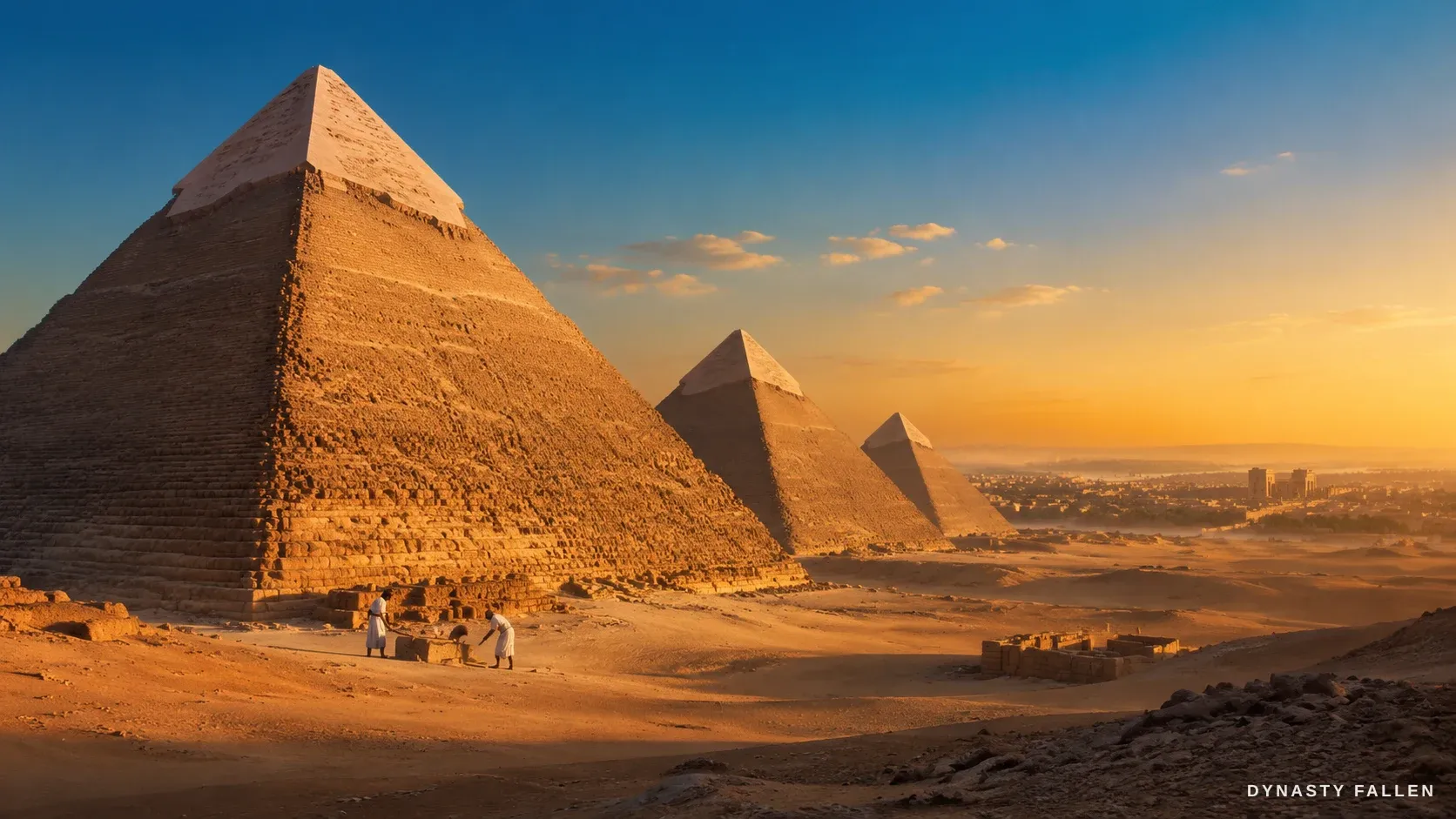
The Pyramids of Giza at golden hour — the three-thousand-year inheritance Cleopatra ruled.
Was Cleopatra Egyptian or Greek?
Both, in the way that mattered. Her dynasty, the Ptolemies, were Macedonian Greeks who had ruled Egypt since Alexander’s general Ptolemy took it in 305 BC — so by blood she was overwhelmingly Greek. But she was the first Ptolemy in three centuries to learn the Egyptian language, and she presented herself to her Egyptian subjects as a native pharaoh and as the goddess Isis. The album takes that self-presentation seriously rather than treating it as costume.
Was Cleopatra really the goddess Isis, or just pretending?
She performed Isis as a matter of state religion, not private belief or mere theatre. Her coins and bilingual decrees give her the title Thea Neotera — “the Younger Goddess” — and the surviving temple relief at Dendera shows her in Hathor-Isis regalia performing rites with her son Caesarion as Horus. To her Egyptian subjects the reigning pharaoh was the god on earth; Cleopatra committed to that identification more completely than any Ptolemy before her. The Truth & Legend page lays out the evidence.
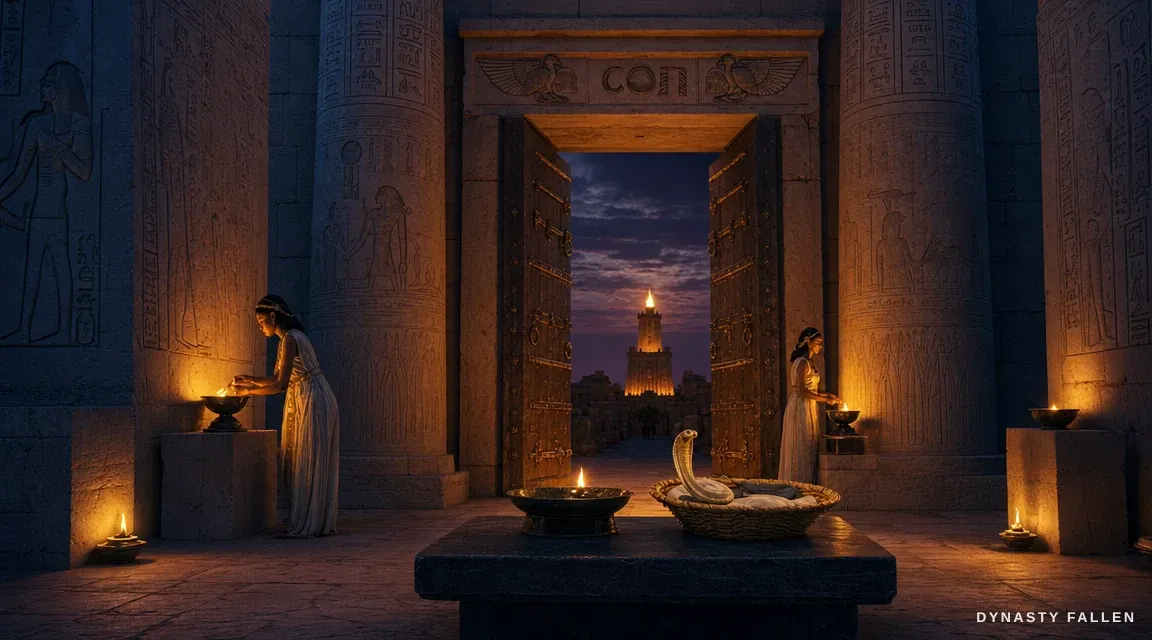
The bronze-bound doors of the temple of Isis at Alexandria.
Did Cleopatra really smuggle herself to Caesar in a carpet?
Not a carpet — that detail is a later embellishment. Plutarch’s word is strōmatodesmos, a bedding-sack or linen bundle, into which Cleopatra was tied and carried past her brother’s guards to reach Caesar in 48 BC. The album’s track The Linen and the Reborn keeps the historical linen rather than the Hollywood carpet; the Truth & Legend entry sorts the two.
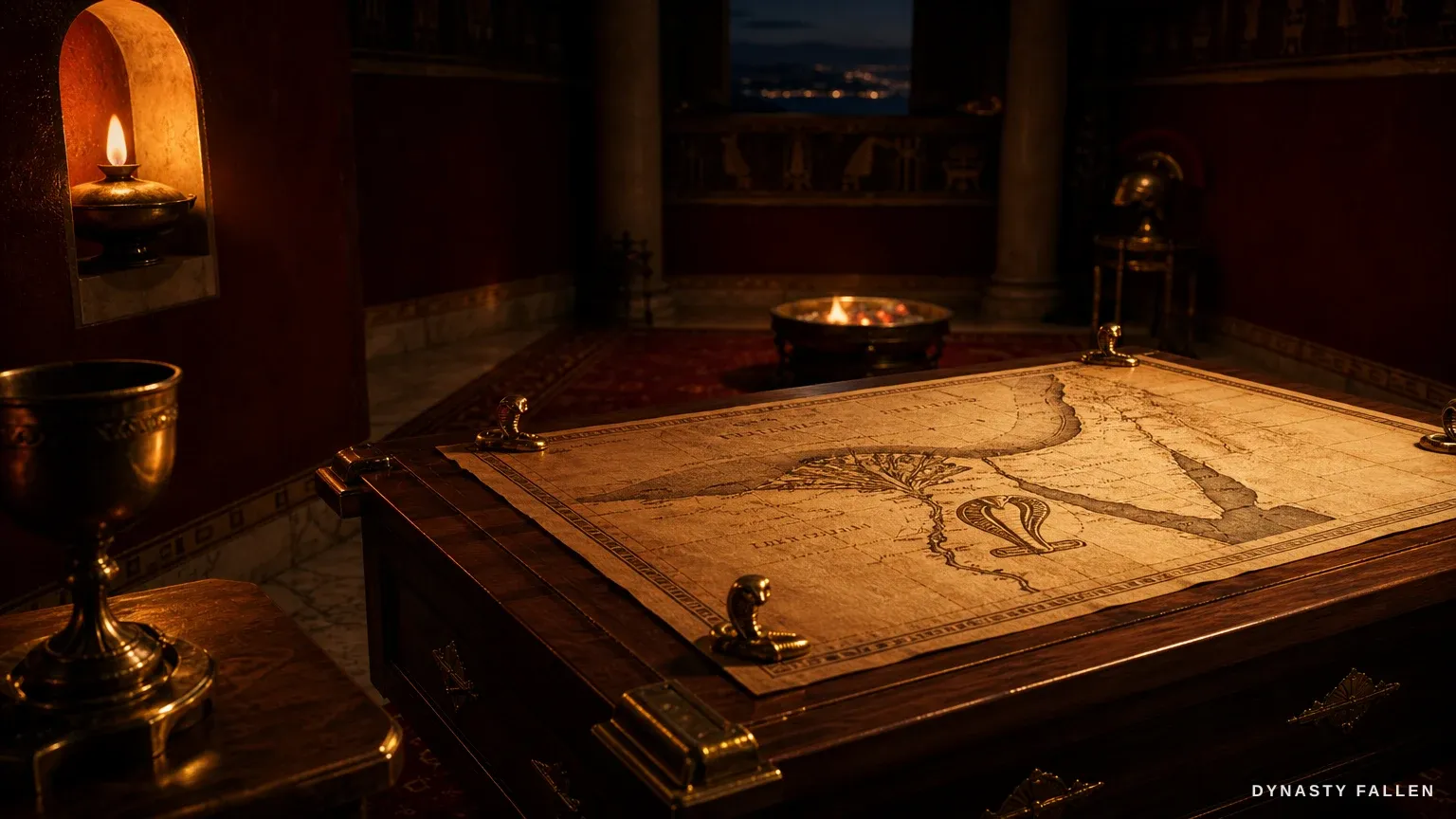
Caesar's chamber by lamplight — the cedar desk and unrolled map.
Was Cleopatra actually beautiful?
Her surviving coins show a hard, hawkish profile with a strong nose and jaw — very far from the Hellenistic-beauty trope. Plutarch himself says her physical beauty was “not in itself incomparable,” and that her real power was her presence, her voice, her wit and her command of languages. The seductress image is largely a Roman and later pop-culture construction; see the Truth & Legend entry.
What were the Donations of Alexandria?
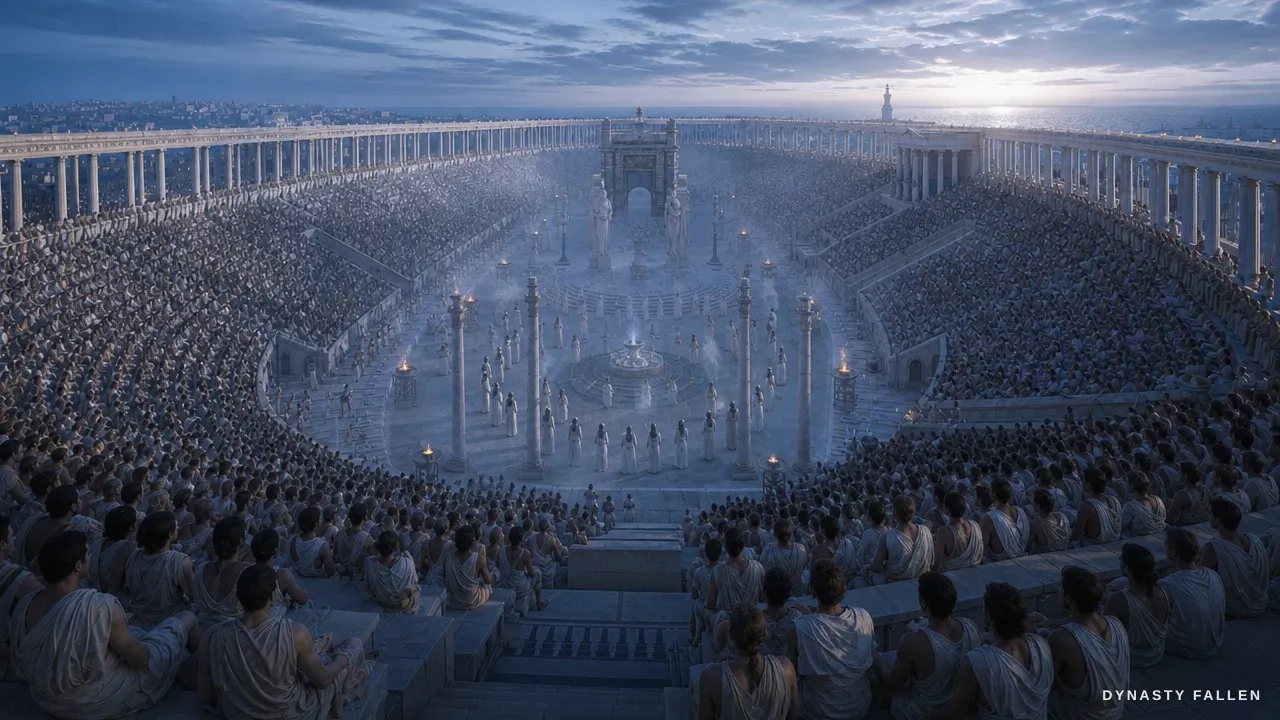
In 34 BC, in the Gymnasium of Alexandria, Cleopatra sat enthroned as Isis while Mark Antony distributed Roman-conquered territories to her children — Caesarion named “King of Kings,” the twins Alexander Helios and Cleopatra Selene and the toddler Ptolemy Philadelphus each given kingdoms. It is attested by three independent hostile Roman sources, which is why even the propaganda tradition cannot deny it happened. It was the act that broke Octavian’s tolerance and led to war. See the Truth & Legend entry.
The Gymnasium of Alexandria packed with crowds for the Donations ceremony.
How did Cleopatra die — was it really an asp?
After Antony’s suicide and the fall of Alexandria in 30 BC, Cleopatra sealed herself in her mausoleum and took her own life rather than be displayed in Octavian’s triumph. The famous asp — an Egyptian cobra, the Uraeus of Lower Egypt — is Plutarch’s dominant account, but he himself notes the marks were faint and the truth uncertain; some sources suggest a poison instead. The cobra is dramatically and symbolically right (it is the crown-serpent of the pharaohs), but the Truth & Legend entry keeps the historical doubt.
How many languages did Cleopatra speak?
Plutarch reports she spoke nine, rarely needing an interpreter — Egyptian, Greek, Latin, Hebrew, Aramaic, Arabic, Median, Parthian and Ethiopian among them. Whether the count is exact or a flourish, the underlying point is documented: she was formidably educated and the first of her line to address Egyptians in their own tongue. The Truth & Legend entry weighs it.
What happened to Cleopatra's children?
Caesarion, her son by Julius Caesar, was killed on Octavian’s order after her death. Her three children by Antony were taken to Rome and raised in the household of Octavian’s sister Octavia; the twins’ later fate is mostly lost, but her daughter Cleopatra Selene II became queen of Mauretania and carried the line on. The Truth & Legend page tracks each.

Where to listen

New tracks drop through the cycle.

Stream the album on your service of choice. Music videos go up on YouTube.