iii.

The Linen and the Reborn

Act I — The Goddess Takes the Throne Released Approx. 4:10
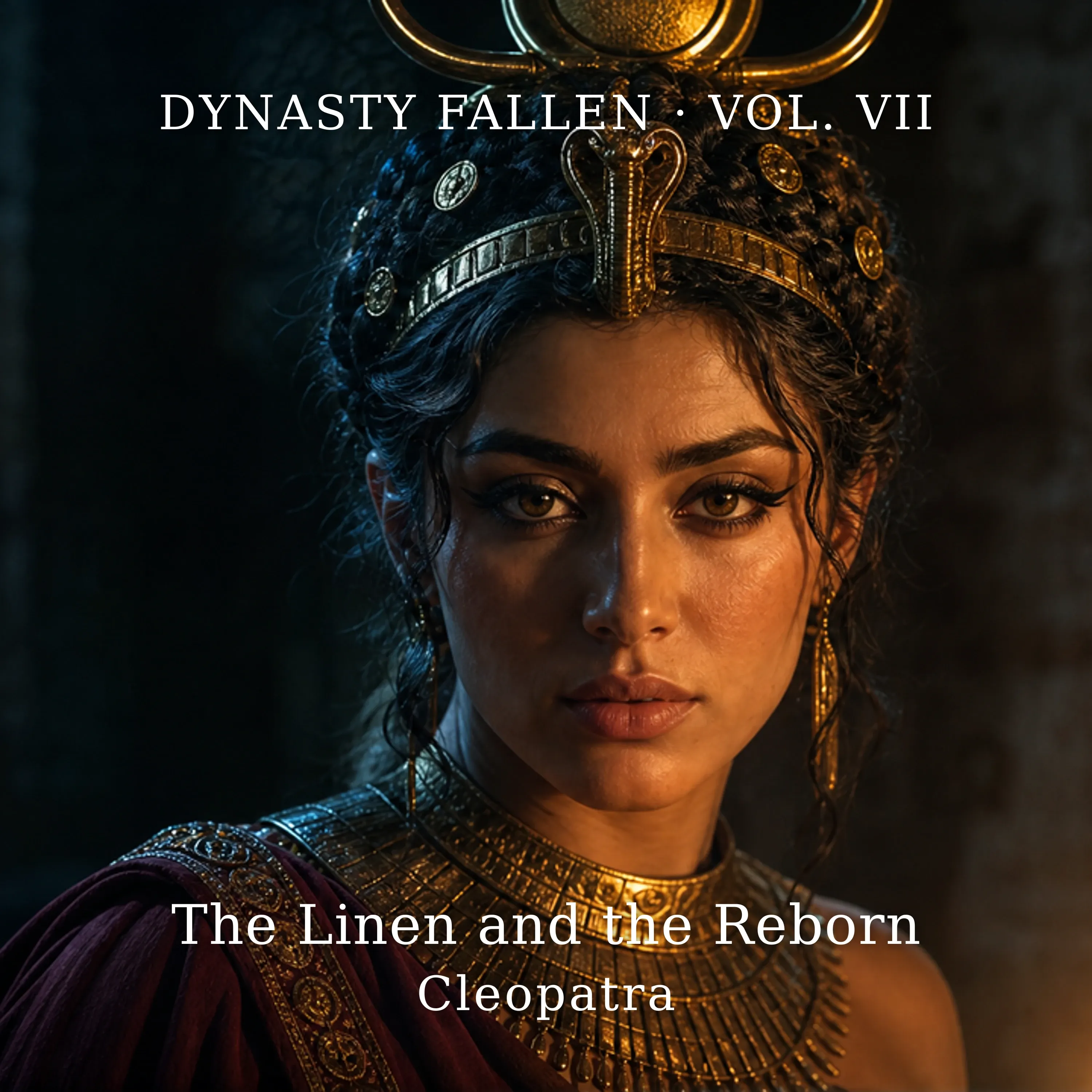
The Linen and the Reborn — track key art. Cleopatra in C2 Isis regalia in three-quarter close, kohl-lined eyes meeting the camera, the gilded Hathor solar-disc-and-horns crown and rearing Uraeus catching warm lamp-light, electrum wesekh collar across her shoulders, wine-red linen and Tyrian-purple robe, the dark stone of the palace receding behind her. The Cinzel wordmark reads ‘The Linen and the Reborn’ over ‘Cleopatra’ with the top banner ‘Dynasty Fallen · Vol. VII’.
Verse 1
Two lines spoken low with an Alexandrian accent over a sparse ney drone and a heartbeat kick at 90 BPM, then sung low-chest, the band still withheld.

I did not ride to Caesar. I did not walk.
I went into the dark, wrapped in linen.
They turned the torches low at the inner gate.
The goddess slept inside the cloth.

Pre-Chorus
Hard tempo lift to 140 BPM. The kit enters, the full band drops in — the knot cut, the linen falling.

The bearers lower the bundle down,
The knot is cut, the linen falls.

Chorus 1
Massive explosion as 140 BPM lands. Full band, twin guitar, priestess chorus.

Out of the dark, into the gold,
The goddess in the linen,
I am the cargo, I am the queen,
And the throne is mine.

Verse 2
Heavier, double-tracked guitars, temple harp, drums driving at 140 BPM. Caesar present only as image — the paused wine cup, the spread maps.

The chamber is mine before I speak.
The wine cup paused, the maps spread wide.
I name the legions one by one.
And the river is louder than Rome.

Chorus 2
Bigger, priestess chorus peak, lead guitar harmony. The last line mutates.

Out of the dark, into the gold,
The goddess in the linen,
I am the cargo, I am the queen,
And Rome is the river's now.

Guitar Solo
16 bars. Lead guitar with ney flute counterpoint, temple drums driving at 140 BPM.
Bridge
The negation chain returns at full power — not as a drop. Twin guitars sustain, priestess chorus rising. The thesis lands.

I did not arrive a captive.
I did not arrive a beggar.
I did not seduce Caesar.
I delivered a kingdom to the room.

Final Chorus
Largest version on the track. Twin lead guitar, priestess chorus, temple drums, ceremonial brass. The closer mutates to the Wadjet motif.

Out of the dark, into the gold,
The goddess in the linen,
I am the cargo, I am the queen,
And the cobra is at his door.

Outro
Sudden cut. Hard ending, no fade.

The door is locked from inside.
The deal is done.

The history

48 BC · the royal palace at Alexandria · Cleopatra smuggled past Ptolemy XIII’s guards in linen bedding and delivered to Caesar’s chambers — the act that won her back her throne

Source: Plutarch, Life of Caesar 49 (the strōmatodesmos, the linen-bundle); Cassius Dio, Roman History 42; the album takes the Egyptian frame over the Roman seductress-myth

Named figures

  • Cleopatra VII Philopator Twenty-one, driven out by her brother-husband; has herself carried back into the palace in linen to reach Caesar and reclaim the throne
  • Julius Caesar Roman dictator wintering in Alexandria after Pharsalus; the man the bundle is delivered to. Present in the track only as image — the paused wine cup, the spread maps — never quoted
  • Ptolemy XIII Her brother-husband and co-ruler; the guards she is smuggled past are his

What this song renders

After losing the throne to her brother’s faction, Cleopatra needed to reach Caesar before her enemies could frame the meeting. Plutarch’s Life of Caesar (ch. 49) records that she had herself bundled into a strōmatodesmos — a sack for bedding or linen — and carried into the palace by a single servant, Apollodorus the Sicilian, past Ptolemy’s guards to Caesar’s rooms. The popular “rolled in a carpet” image is a later embellishment; the word in the source is linen, not carpet.

The album refuses the Roman reading of this scene as seduction. The frame here is Isis going into the dark to be reborn — the goddess delivered in linen, unwrapped, and revealed in full Isis regalia. The track keeps Caesar silent and off-centre on purpose: the historical outcome was that Caesar restored Cleopatra to the throne and backed her against her brother, and the song reads that as a kingdom delivered, not a man seduced. The bridge states it flat: I did not seduce Caesar — I delivered a kingdom to the room.

What the song dramatises beyond the record is interior: Cleopatra’s own framing of the smuggling as a deliberate political act rather than a romantic one. The Roman tradition that gives us the seductress-Cleopatra was written by the regime that destroyed her; the album sides with the reading in which a deposed queen used the one route left to her to reach the only power that could restore her.

Verdict

The smuggling itself is documented — Plutarch names the linen-bundle and the servant Apollodorus, and Caesar’s subsequent restoration of Cleopatra’s throne is firmly attested. The “carpet” is a later flourish (the source says linen). The reframe — the act read as goddess-rebirth and kingdom-delivery rather than seduction — is the album’s interpretive stance, not a claim of fact; the Roman sources frame the same events as seduction.

See the full Truth, Saga & Legend entry