iii.

The Crown Comes Off

Act I — The House Released Approx. 4:05
Verse 1
Two lines spoken, then the band detonates — a stampede of war drums and frenzied balalaika over surging low strings.

A hundred thousand throats in the square, screaming the throne to the ground,
the rifles turned on their officers, and the red came down like snow,
The Cossacks broke, the city burned,
the red flags ate the sky,
they tore the eagle off the gate,
and spat where the saints had stood,
three hundred years in a week of fire,
and the mob took the throne by the throat.

Pre-Chorus

They came through the palace gates like a flood,
and the locks meant nothing now.

Chorus
Full band, war drums, tubular bells, women's chorus snarling like a mob, soprano lift.

The crown comes off,
the streets run red,
the emperor of all the Russias
is dragged from his own bed,
they bow no more, they burn the throne,
and they howl us all away.

Verse 2
Same palette, harder, galloping.

They called him citizen, threw the crown in the mud,
the double eagle burned in a soldier's fire,
they herded us onto a train going east,
to a house whose name was made of fear.

Pre-Chorus

They came through the palace gates like a flood,
and the locks meant nothing now.

Chorus 2
Bigger, women's chorus layered.

The crown comes off,
the streets run red,
the emperor of all the Russias
is dragged from his own bed,
they bow no more, they burn the throne,
and the red tide drags us down.

Bridge
Half-time drop to harmonium and an exposed mezzo, then a violent full-band return.

Three hundred years of Romanov,
three hundred years of gold,
torn down in a screaming winter,
to four girls in the cold.

Final Chorus
Biggest, angriest — double bass drums, full women's choir.

The crown comes off,
the streets run red,
the emperor of all the Russias
is dragged from his own bed,
they bow no more, they burn the throne,
and the train rolls toward the cellar.

Outro
A hard cut from the full band into near-silence, no fade.

Three hundred years,
and a door that locked from outside.

The history

Petrograd and imperial Russia, February–August 1917 — the Revolution, the abdication, and the family’s removal east toward captivity

Source: Standard histories of the February Revolution and the abdication of Nicholas II; Massie, Nicholas and Alexandra. See Truth & Legend.

Named figures

  • Nicholas II The last Tsar; abdicates and becomes ‘citizen Romanov,’ dragged from rule and herded east with his family
  • Anastasia Nikolaevna The still center against the riot; herded with the family onto the train east, the white court dress now under a plain coat
  • The revolutionary crowd The mass upheaval — striking workers, mutinying soldiers, mob and Cossacks — that tears down a 300-year dynasty
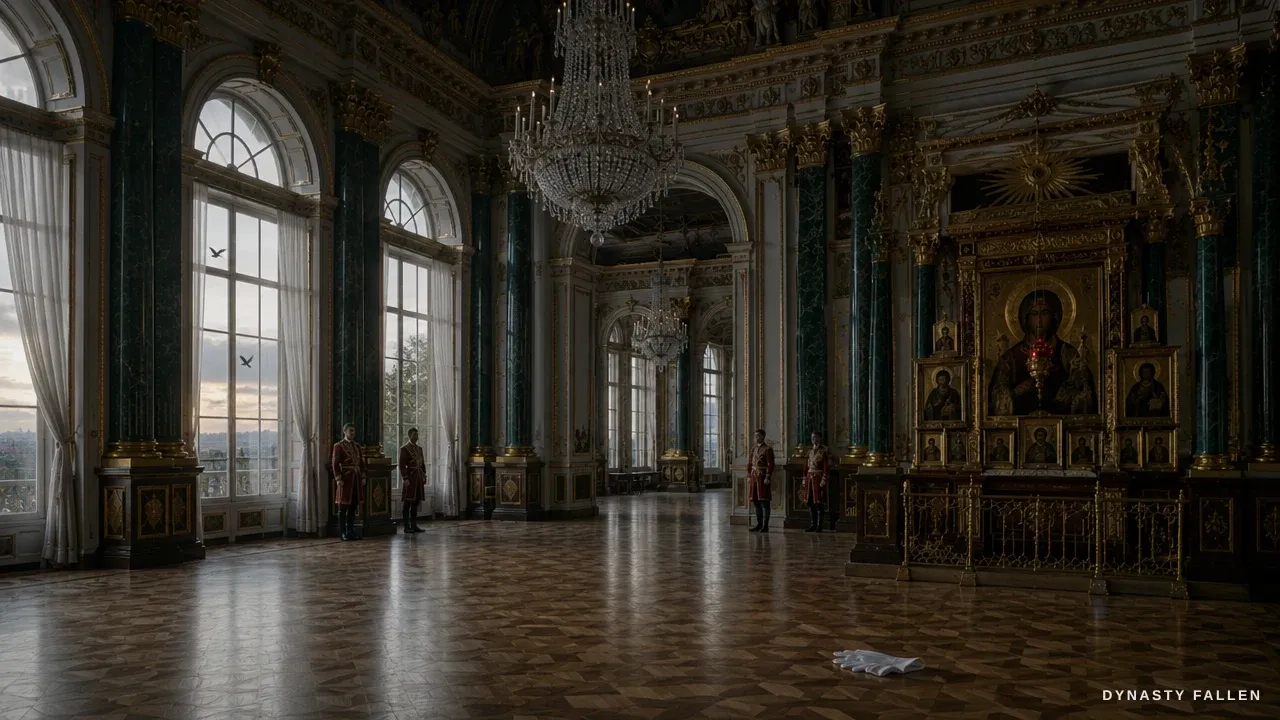
The palace hall, its grandeur dimmed — the crown coming off.

What this song renders

The events the song renders are documented. The February Revolution of 1917 — mass strikes in the capital, the Petrograd garrison mutinying, soldiers turning on their officers — forced the abdication of Nicholas II in March, ending three centuries of Romanov rule. Crowds tore down and burned the imperial symbols, including the double-headed eagle of the Romanov arms; the deposed Tsar was reduced to ‘citizen Romanov.’

The family passed from palace house-arrest to internal exile, moved east by train — first to Tobolsk and ultimately to the Ipatiev House in Yekaterinburg. The song renders the upheaval as image and action at scale and distance rather than as documentary procedure, but the shape is accurate: a dynasty collapsing in a screaming winter, leaving ‘four girls in the cold.’

The closing lines — ‘a house whose name was made of fear’ and ‘the train rolls toward the cellar’ — are deliberate foreshadowing of the captivity and execution the album reaches in Acts II and III; the song itself does not depict the cellar.

Verdict

The Revolution, the abdication, the burning of the imperial eagle, and the removal east are documented history. The track dramatises mood and motion rather than any single quoted episode; nothing here is invented for effect. See Truth & Legend.

Read the full Truth, Saga & Legend page