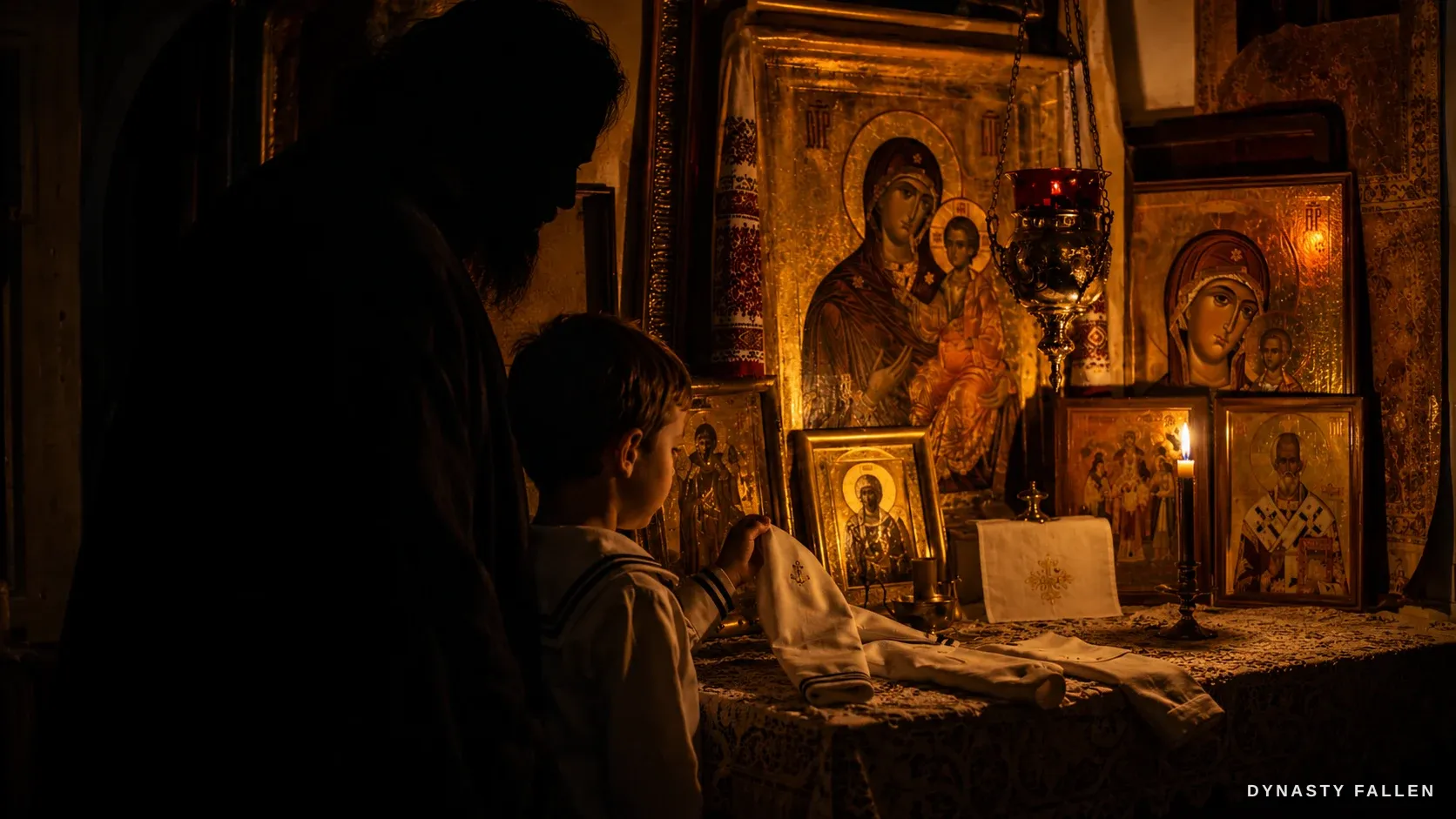
What this song renders
The track’s spine is documented. Alexei, the only son and heir, carried haemophilia — a hereditary bleeding disorder kept as a state secret because the empire’s future rested on a child one fall could kill. The desperation around his condition is what drew Grigori Rasputin, a Siberian peasant mystic, into the imperial family’s intimate circle: he appeared able to calm the boy’s crises when court physicians could not.
Rasputin’s influence at court and the scandal it generated are also documented — the whispers that ‘painted us as rotten,’ the sense of a throne kneeling to a peasant. The song renders him only in narration and silhouette, never as the cartoon sorcerer of the films and never with a clear face or a moving mouth. The ‘holy man’ is a looming function, not a character who speaks.
The bridge’s reframe — that the deepest rot was not the mystic or the throne but a mother’s terror for a son she could lose at any moment — is the song’s interpretive move rather than a documented quotation, but it rests on the real medical and emotional facts of Alexandra’s situation.
Alexei’s haemophilia, its concealment, and Rasputin’s court influence are all documented. The supernatural ‘curse’ framing of the films — that Rasputin’s dark magic doomed the dynasty — is pure invention; he was murdered in December 1916, eighteen months before the family. See Truth & Legend.