viii.

The Wineskin

Act III — The Collecting Released Approx. 3:24
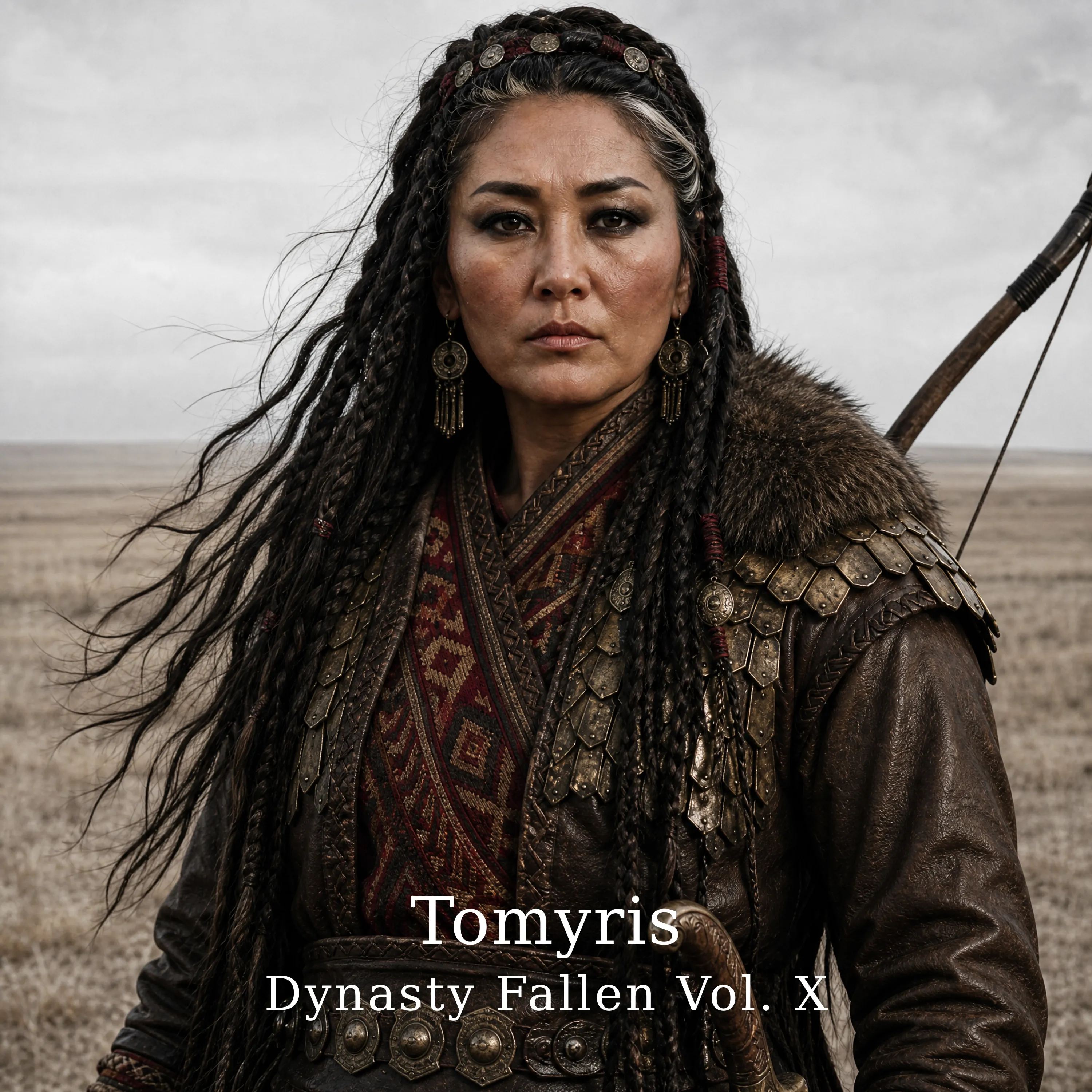
Tomyris of the Massagetae — album cover. The steppe warrior queen in bone-white and oxblood wool, bronze scale at the shoulder, kohl-lined eyes, dark warrior braids, before a cold bone-white dawn over the open grass.
Verse 1
Female mezzo sung, dry and intimate. Low strings and a single low drone, a frame-drum heartbeat. No choir, no lift.

I told you, I told you, I told you what would come
You did not believe the grass
I walk the field at dusk, I turn them over
I find you in the dust at last
No crown now, no guard now, no name they will write down
Just a man the grass took back

Chorus
Low strings forward, heavy guitar restrained, no lift.

Drink, Cyrus, drink the river you crossed for
The thirst you brought, the thirst you became
The wineskin is full, the word is kept
The word is kept

Verse 2
Band held at half-power. The filling, described plainly.

I kneel, I take the skin
I fill it from the open ground
I do not look away, I do not pray
I do not make a sound
This is not for the gods, this is not for the song
This is the thing I swore I'd do
You wanted the steppe, you wanted the blood
Now the wineskin holds them both, for you

Chorus
Heavier low strings. The closer mutates colder.

Drink, Cyrus, drink the river you crossed for
The thirst you brought, the thirst you became
The wineskin is full, the word is kept
I keep my word

Bridge — The Crossing
Spoken, dry close-mic, a single low drone. Then a hard cut to silence.

You thirsted for blood, Cyrus.
Now drink your fill.

Outro
A single low drone falling to silence. No vocal. Hard cut.

The history

Mid-sixth century BC · the Massagetae lands, the battlefield aftermath east of the Caspian Sea

Source: Herodotus, Histories 1.214; the later writers who depend on him

Named figures

  • Tomyris Queen of the Massagetae — the woman who keeps the vow, finds Cyrus among the dead, and fills the wineskin with blood
  • Cyrus the Great Founder of the Achaemenid Persian empire, killed in the campaign against the Massagetae; his body found and beheaded, his head dunked in the skin
  • Spargapises Her son — dead by his own hand before this track; the debt this act answers

What this song renders

The scene the song renders is the single most famous moment in the whole record of Tomyris, and it comes from Herodotus alone. After the Massagetae destroy the larger part of the Persian army and Cyrus falls, Tomyris has the field searched for his body. When it is found she has the head struck off and pushes it into a wineskin she has filled with human blood — ‘I warned you I would give you your fill of blood, and so I shall’ (Herodotus 1.214). The line the album sets — ‘You thirsted for blood, Cyrus. Now drink your fill’ — is the compressed, address-form version of the same speech.

Herodotus himself flags the limit of his own report. Having given this version of Cyrus’s death, he adds that ‘of the many accounts of how Cyrus died, this seems to me the most credible’ — an admission that other deaths circulated. Other ancient writers have Cyrus die elsewhere and otherwise; Xenophon gives him a peaceful end in bed. So the wineskin is the best-attested version of a contested death, not a fact beyond dispute — but it is the version that fixed Tomyris in the Western imagination for two and a half thousand years.

The song renders the keeping of the vow, not the gore. The head-severing and the filling are withheld; what the track holds is the calm — the woman kneeling in the dust, taking the skin, making no sound, collecting a debt she swore in Track 05 to collect. The chorus mutates from the word is kept to I keep my word: ritual closure becoming a colder first-person claim, and then the bridge crossing, and then silence.

Verdict

The wineskin and the ‘drink your fill’ speech come from Herodotus 1.214, who calls it the most credible of several accounts of Cyrus’s death — so it is best-attested, not undisputed (other ancients, e.g. Xenophon, give Cyrus a peaceful end). The lyric quote is the compressed address-form of the Herodotus speech. See Truth & Legend.

See the full Truth, Saga & Legend entry