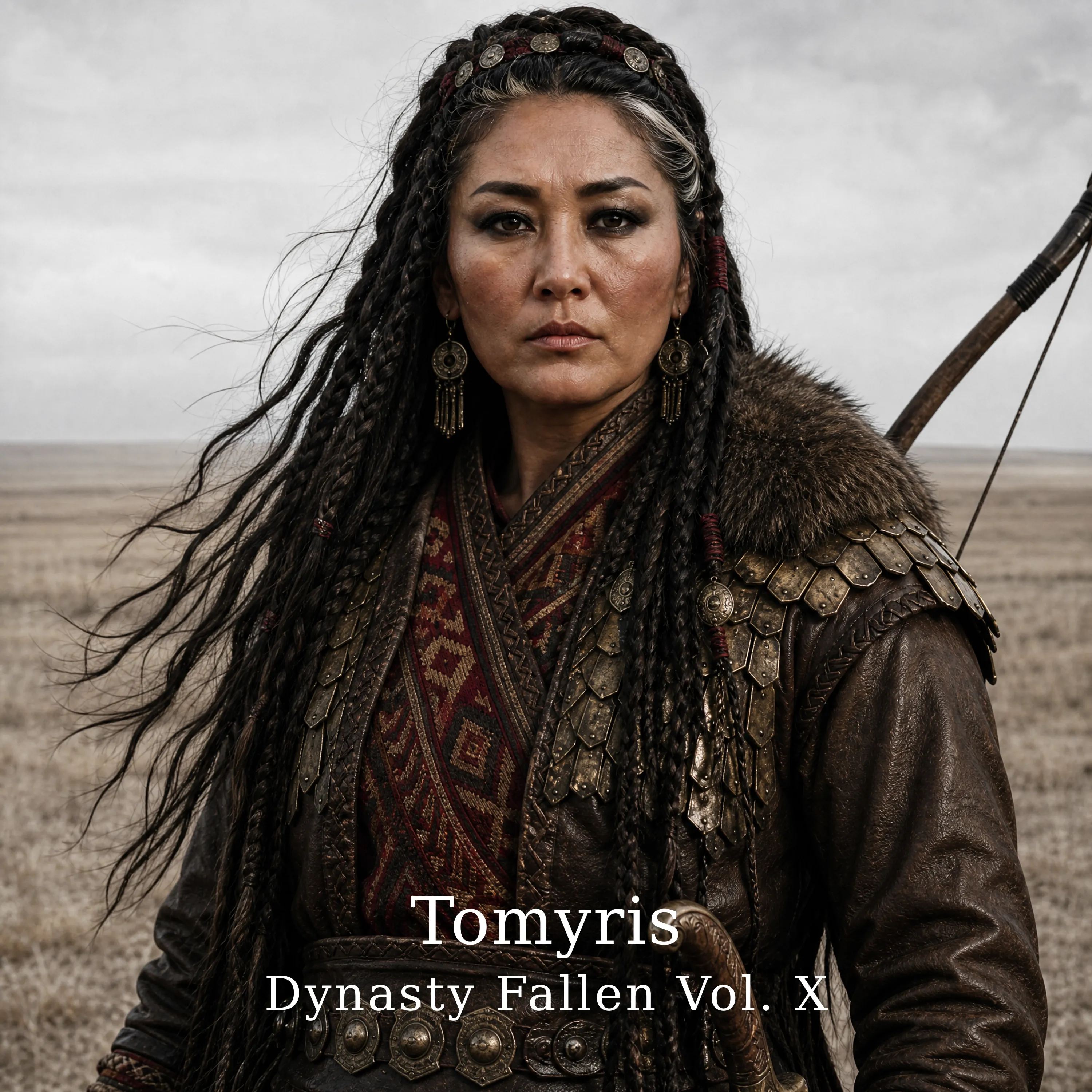
What this song renders
The closer states a documented asymmetry. Herodotus gives Tomyris a finished story — the warning, the refused offer, the trap that took her son, the answer that took Cyrus (Herodotus 1.205–214). The Persian record gives her nothing: no royal inscription, no relief, no acknowledgement that the empire’s founder died on a campaign east of the Caspian. The Behistun and Cyrus-era texts that do survive say nothing of her. She reaches us through a single Greek line of transmission, half-erased on the Persian side.
And she has no monument to anchor the name. There is no securely identified tomb, no temple, no coin, no contemporary portrait — nothing of the kind that fixes a king in the ground. The Massagetae left no cities to be sacked and no carved names to be toppled, so there was, almost literally, nothing of hers to erase: the song’s thesis is that the act outlasted the absence of any record built to hold it. ‘There was nothing they could erase that mattered.’
The album closes on that afterlife. In modern Central Asia — and in popular culture beyond it — Tomyris has been reclaimed as a founding warrior-queen, her name attached to statues, films, and national memory she never asked for and the ancient record never granted. The grass-remembers frame is the song’s figure for it: the country and its memory outlasting the empire that came for it, and the record that left her out. The Cyrus Cylinder is lit in its case; her name is on no panel; the grass keeps the rest.
The asymmetry is real — Herodotus preserves her, the Persian record is silent, and no securely identified tomb or monument survives (Herodotus 1.205–214). The modern reclamation of her name is an afterlife the ancient sources never granted. See Truth & Legend.